Adventure and Outdoor Activities in Siem Reap & Angkor Wat
A visual guide from the Siem Reap and Angkor Wat travel guide — see all posters in Visual Guides.
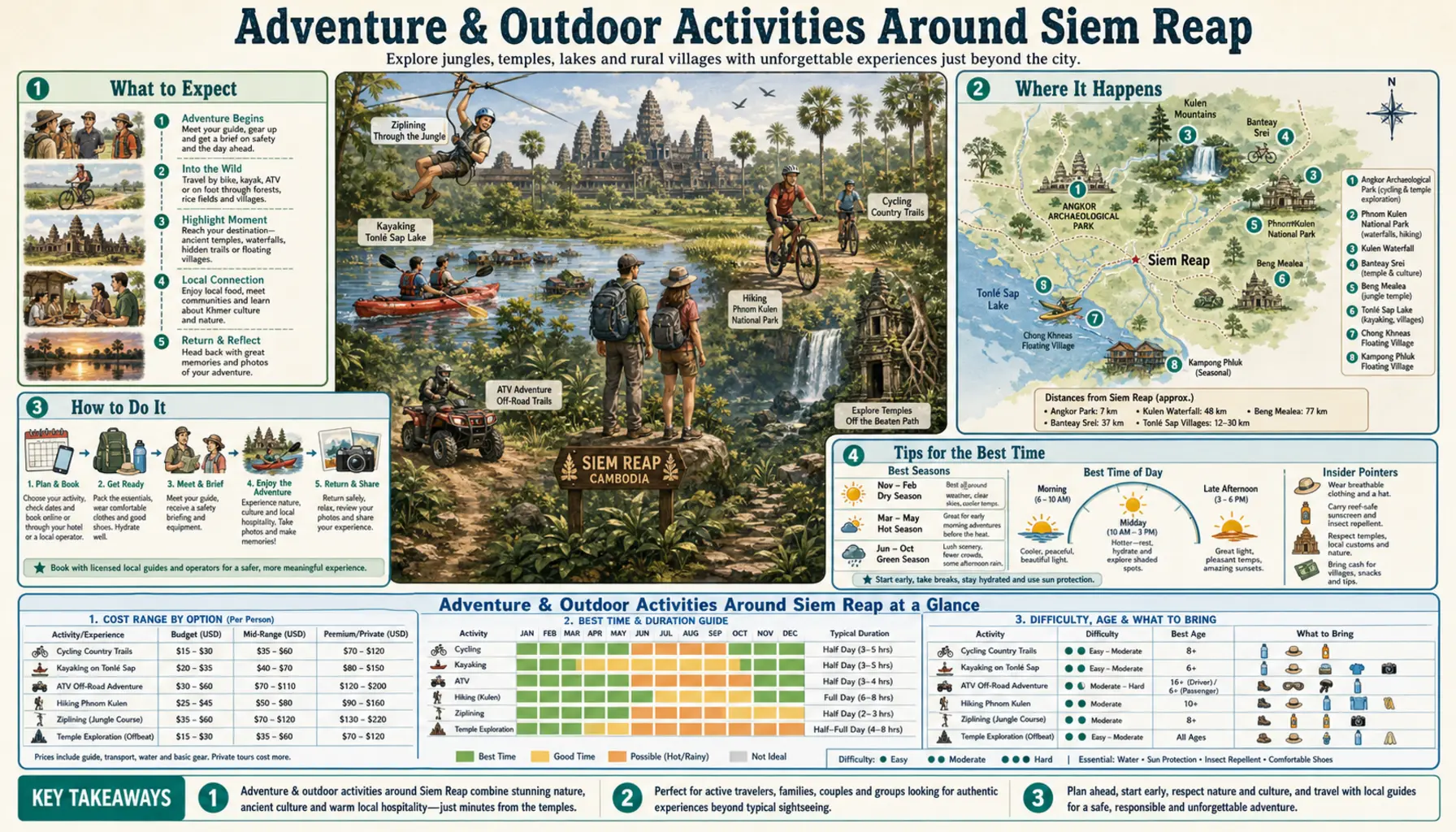
Most people arrive for the temples and leave surprised by how much of Siem Reap happens outdoors and at ground level. By six in the morning the laterite lanes west of town are cool enough to cycle, cattle egrets lifting off the paddies as you pass. By late afternoon the West Baray — an eleventh-century reservoir eight kilometres long and still holding water — fills with families wading off its sandy southern shore. In between there is kayaking through flooded forest at Kampong Phluk, quad bikes on red-dust village tracks, and balloon and helicopter flights that finally put Angkor Wat's five towers in proper scale.
Water, forest and dust tracks
The West Baray, roughly 10 km west of the centre, is the closest thing to open water: locals rent inner tubes and thatched picnic platforms along the southern bank, and small kayaks are usually available. For flooded forest, head south-east to Kampong Phluk at about 30 km, or push on to Prek Toal, the waterbird colony that forms a core zone of the Tonlé Sap Biosphere Reserve, reachable by boat in roughly two hours. North of town, Phnom Kulen National Park has walkable jungle trails and two waterfalls with deep plunge pools. The rice-field lanes toward Puok are where quad-bike and dirt-bike operators run their sunset loops.
Timing and practicalities
Everything outdoors here is governed by heat. Aim to be moving by 06:00 and off the bike or trail by 10:30, then out again after 16:00. The wet season, roughly June to October, brings short heavy downpours but also the high water that makes the flooded forest and Prek Toal worth the trip; March to May is punishing and often well above 35°C. Anything inside the Angkor Archaeological Park — cycling, or the tethered balloon that flies near the Angkor Wat causeway when it is running — needs a valid park pass, and Phnom Kulen charges its own separate entry. Book helicopter or microlight flights a day ahead, and confirm zip-line operations are actually running before committing.