Botanical Gardens in Siem Reap & Angkor Wat
A visual guide from the Siem Reap and Angkor Wat travel guide — see all posters in Visual Guides.
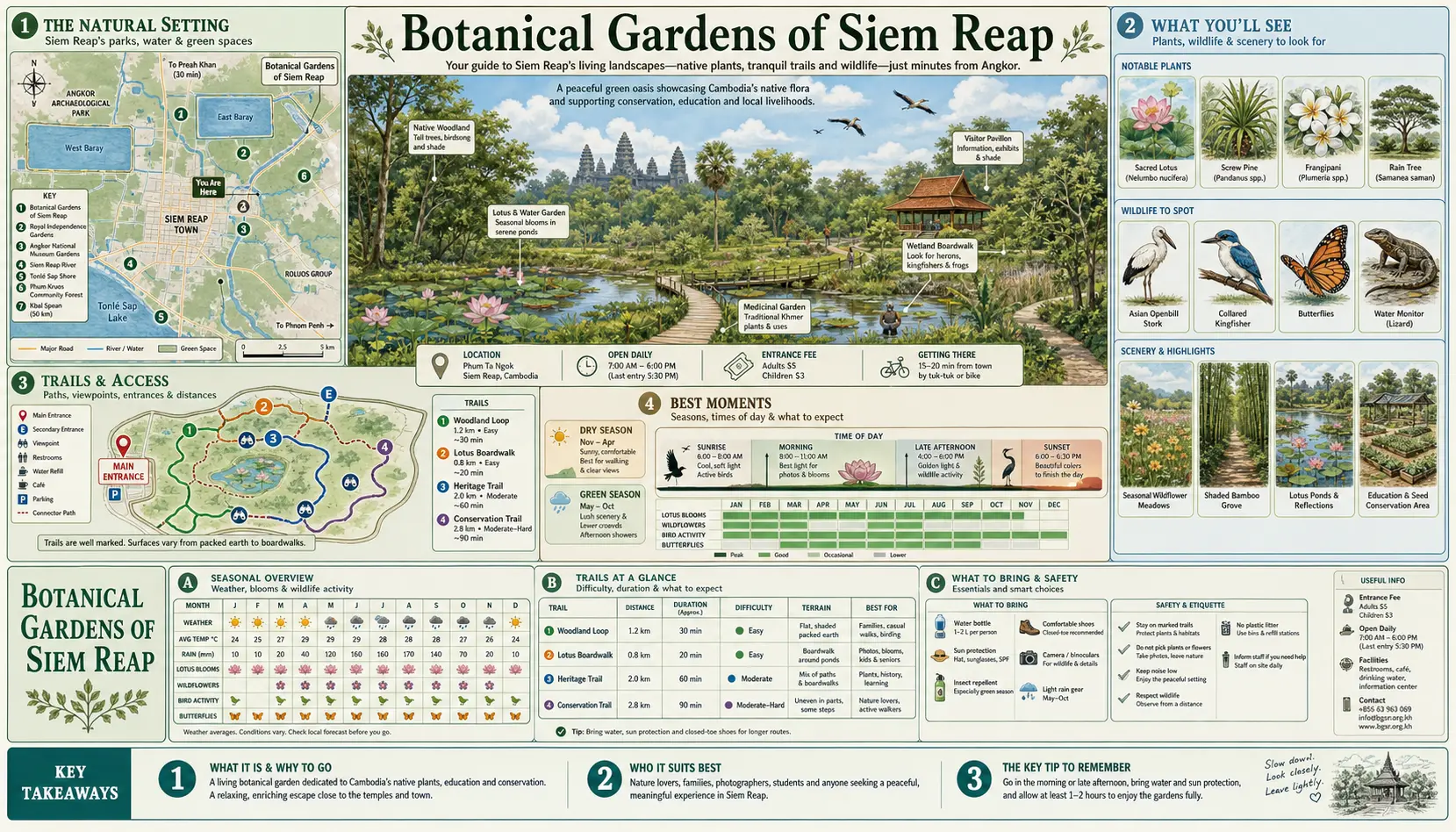
Siem Reap has no grand formal botanic garden, and the town is more interesting for it. The green set piece is the Royal Independence Gardens, a small block of lawn and old rain trees between the river and Charles de Gaulle Road, where a colony of large fruit bats hangs in the crowns all day and lifts off in a long ragged stream at dusk. Beyond that, the real botany is inside the Angkor park, where silk-cotton and strangler fig have grown into the sandstone at Ta Prohm and Ta Som over roughly two centuries.
Where the greenery is
The Royal Independence Gardens sit opposite Raffles Grand Hotel d'Angkor and take ten minutes to walk; come around six in the evening for the bats. Inside the Angkor park, the forested stretches linking Preah Khan, Neak Pean and Ta Som give the most atmospheric walking, and the tree-lined causeway to Angkor Thom's south gate holds proper shade. West of town, the Angkor Silk Farm at Puok grows mulberry for its silkworms and is laid out as a working plantation you can walk through. Near Banteay Srei, the Angkor Centre for Conservation of Biodiversity runs guided visits past rescue enclosures and through secondary forest.
Trees to look for, and when
The signature tree at Ta Prohm is the pale, smooth-barked giant that guides call silk-cotton — botanically it is usually Tetrameles nudiflora — with roots pouring over the galleries; the darker, ropier ones twisting through doorways are strangler figs. Frangipani and flame trees flower across town in the hot months, roughly March to May, and the rains from June turn the whole plain a hard, saturated green. Lotus fills the barays and roadside ponds through the wet season, and the sugar palms standing alone in the paddies are tapped for palm sugar in the cool dry months. Early morning gives the best light and the most birdlife, and the forested park sections stay comfortable an hour longer than the open temples.