Digital Nomads in Siem Reap & Angkor Wat
A visual guide from the Siem Reap and Angkor Wat travel guide — see all posters in Visual Guides.
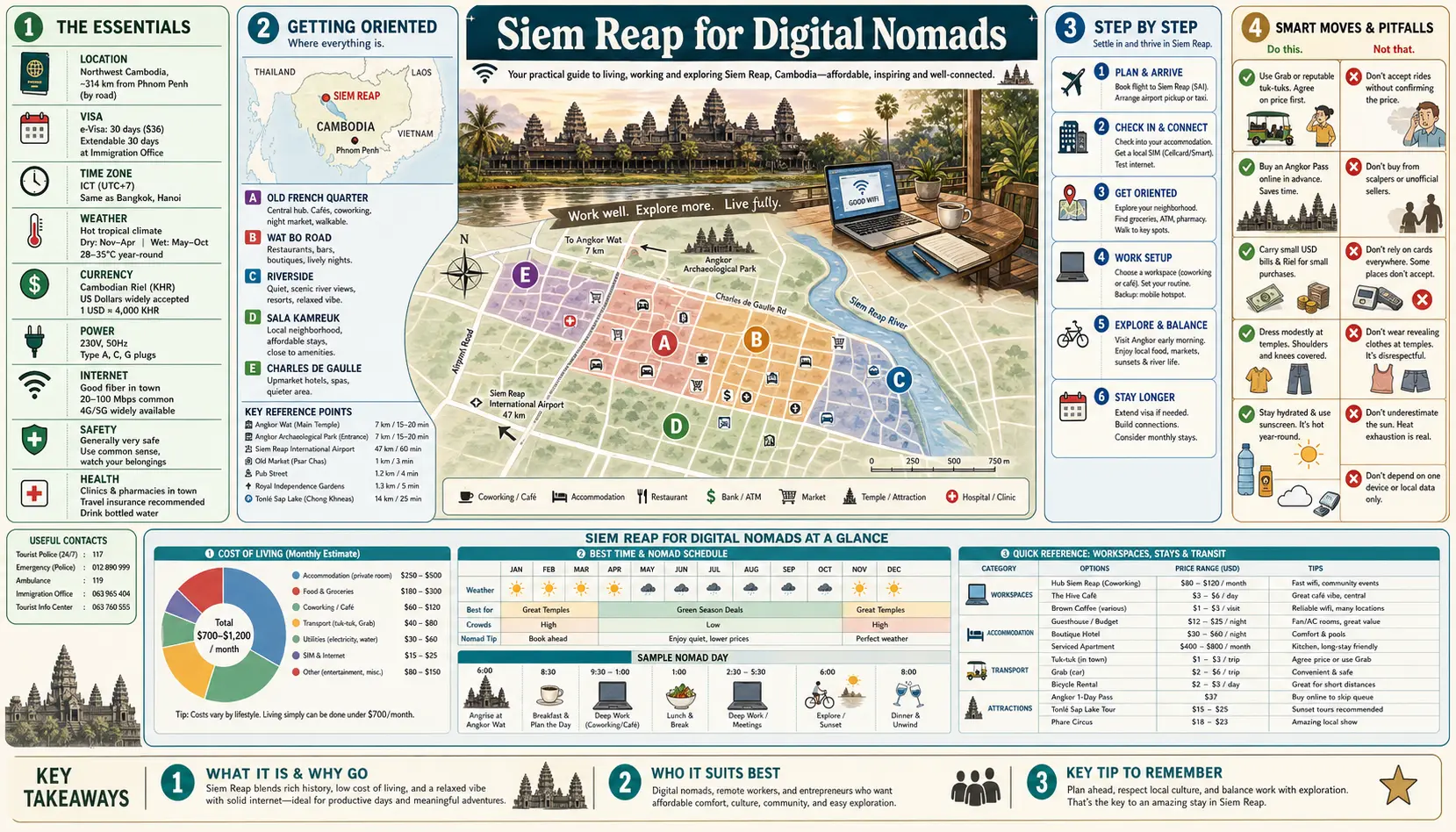
By nine in the morning the laptop crowd has already claimed the shaded tables at Little Red Fox Espresso in Kandal Village, iced coffee sweating onto the tiles while the tuk-tuk drivers outside wait for the temple run to end. Siem Reap has quietly become one of Southeast Asia's cheapest bases for remote work: fibre broadband in most cafes, a compact centre that takes fifteen minutes to cross by bicycle, and rent that undercuts Chiang Mai or Da Nang. The trade-off is scale — the community is small, and April's heat is punishing.
Where to work
AngkorHUB, out towards the Wat Bo side of the river, has long been the best-known dedicated coworking space and is usually the easiest place to meet other remote workers; 1961 mixes desks with a gallery and events. Most people, though, work from cafes. Little Red Fox Espresso and Sister Srey near the Old Market are the classic laptop spots, Temple Coffee n Bakery has strong air conditioning and long opening hours across several branches, and Footprint Cafe on the Wat Bo side pairs decent wifi with a secondhand bookshop. Expect to pay for a drink every couple of hours rather than a cover charge.
Costs and practicalities
A furnished one-bedroom in the Wat Bo or Sala Kamreuk areas typically runs somewhere around US$250–400 a month, and a monthly coworking desk usually lands near US$60–90. Local SIMs from Smart, Cellcard or Metfone are cheap and data allowances are generous — a tourist data pack often costs only a few dollars. Power cuts are occasional rather than constant, so cafes with generators are worth knowing. On visas, the ordinary E-class business visa is the one most long-stayers use because it can be renewed indefinitely, whereas the tourist visa extends only once. Rules change, so check current requirements before booking a long stay.