History Timeline in Siem Reap & Angkor Wat
A visual guide from the Siem Reap and Angkor Wat travel guide — see all posters in Visual Guides.
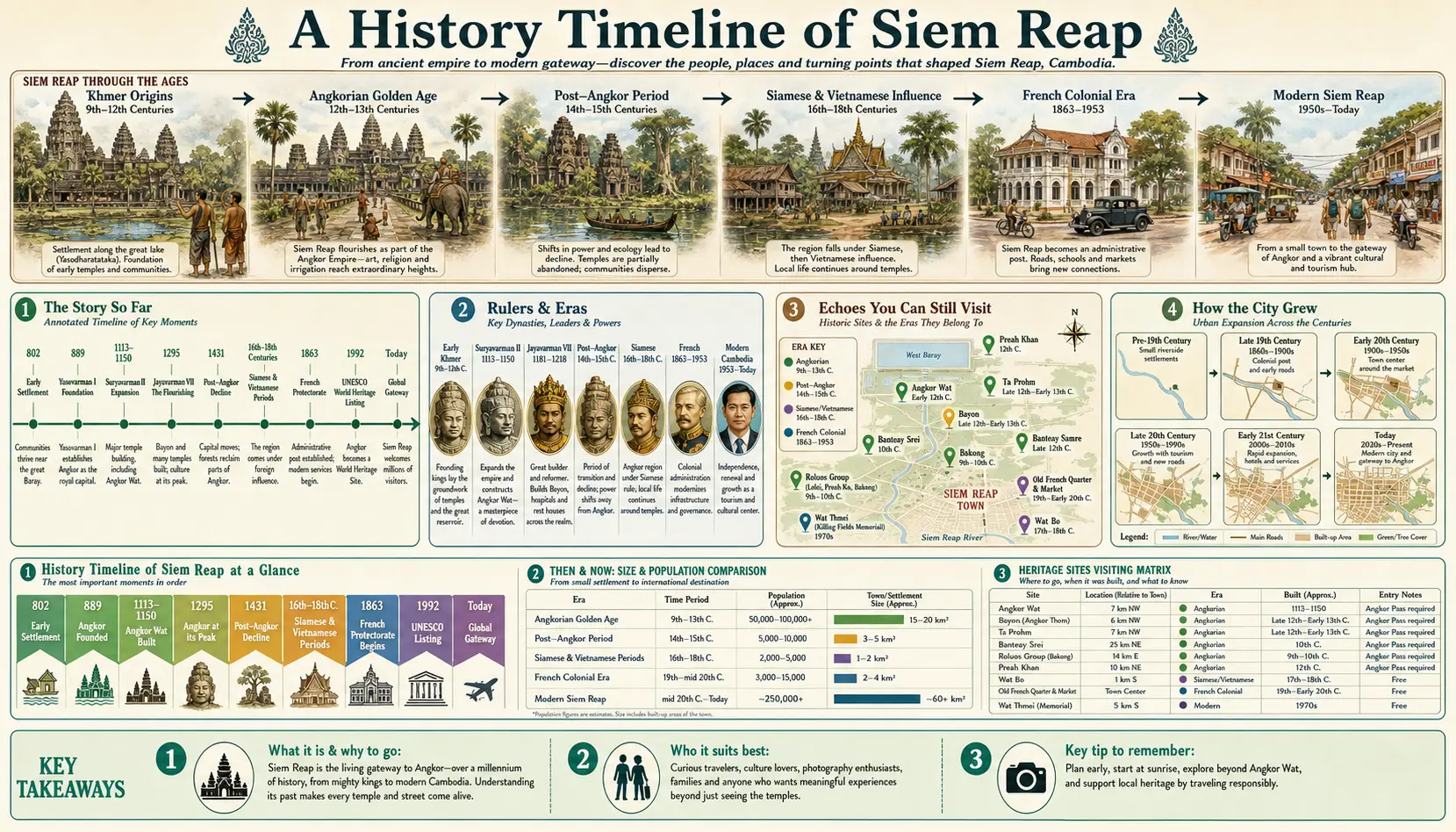
Angkor was not a single project but roughly six centuries of continuous building. The conventional start date is 802 CE, when Jayavarman II declared an independent kingdom on Phnom Kulen, the sandstone plateau whose quarries supplied the temples below. By the twelfth century the capital held hundreds of thousands of people and a hydraulic network of reservoirs and canals that lidar surveys have since mapped in remarkable detail. Understanding that sequence changes how the sites read: Angkor Wat and the Bayon look similar to a first-time eye but are separated by two generations and a change of religion.
Rise and peak
After 802 the capital shifted several times before Yasovarman I established Yasodharapura around Phnom Bakheng near the end of the ninth century. The two defining reigns came later: Suryavarman II, who built Angkor Wat between roughly 1113 and 1150 as a Vishnuite temple aligned to the west, and Jayavarman VII, who from 1181 rebuilt the capital as Angkor Thom with the Bayon at its centre and added Ta Prohm, Preah Khan and Banteay Kdei in a single extraordinary building programme. The switch from Hindu to Buddhist iconography between those reigns is visible in the carvings.
Decline, rediscovery, restoration
Angkor was sacked by Ayutthaya in 1431 and the political centre moved south towards Phnom Penh, though the site was never truly abandoned — monks maintained Angkor Wat continuously. European interest followed Henri Mouhot's account of his 1860 visit, published after his death, and from 1907 the École française d'Extrême-Orient began clearing and rebuilding, using anastylosis to reassemble Banteay Srei and, far later, the Baphuon, whose reconstruction took some five decades and finished in 2011. UNESCO listed Angkor in 1992 and kept it on the endangered list until 2004. Restoration teams from India, Japan, China and Germany still work across the park.