Mosques and Islamic Heritage in Siem Reap & Angkor Wat
A visual guide from the Siem Reap and Angkor Wat travel guide — see all posters in Visual Guides.
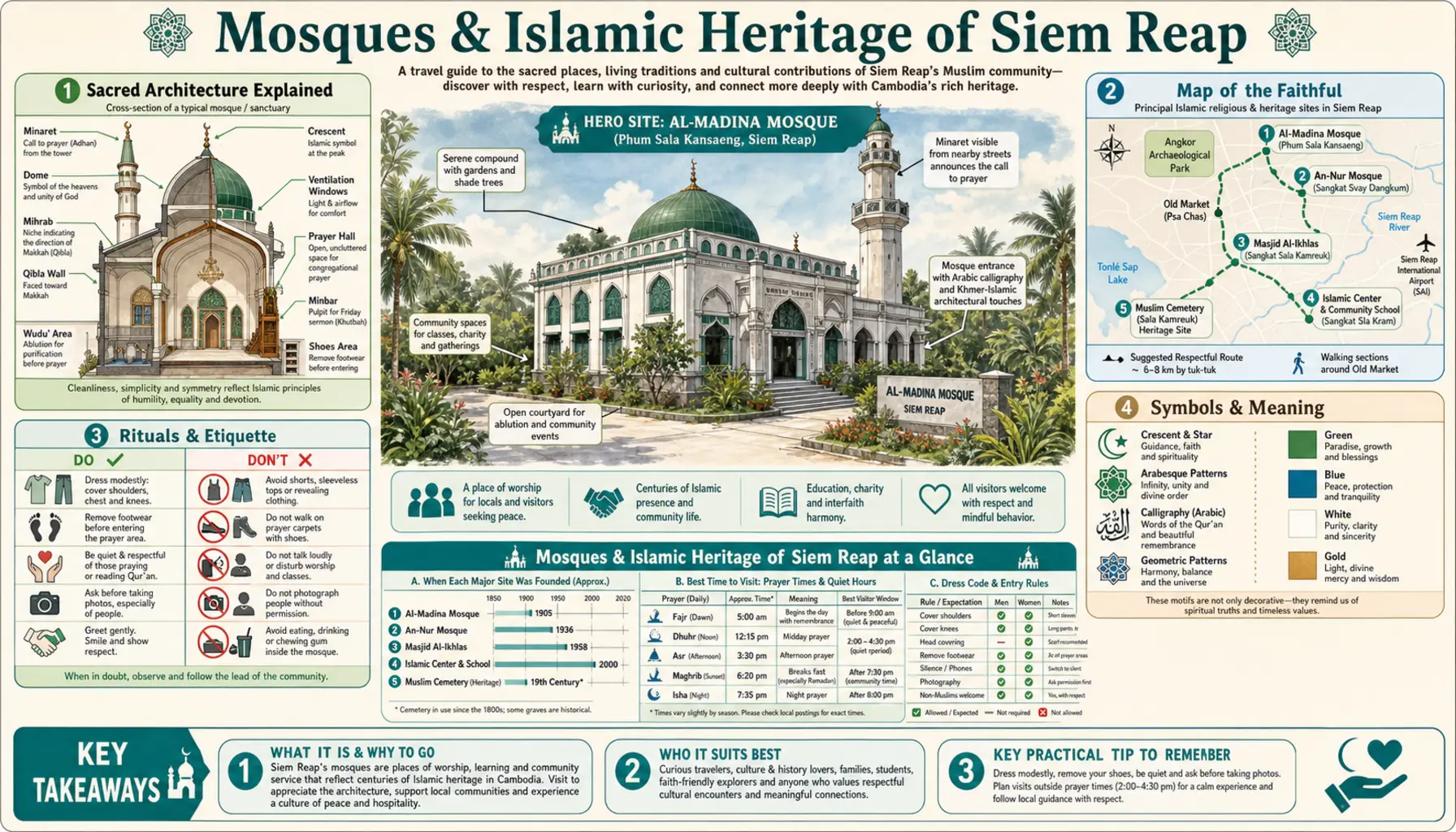
On the Bayon's outer gallery a carved naval battle runs for several metres: two fleets locked together on the Tonlé Sap, crocodiles taking the men who fall overboard, and one side wearing distinctive helmets shaped like inverted lotus flowers. Those are Cham sailors, from the kingdom that sacked Angkor in 1177 before Jayavarman VII drove them back out. Their descendants never left the region. Cambodia's Cham Muslim community, several hundred thousand strong nationally, still works the same lake, and Siem Reap's mosques stand among the villages on the road down to it.
Where the heritage is
The carvings are the oldest layer and the easiest to find: the Bayon's south-eastern outer gallery for the naval battle and the land campaign that followed, with further Cham war scenes on the walls of Banteay Chhmar, far to the north-west near the Thai border. For the living community, the villages strung along Route 6 east of town and around Phnom Krom toward the lake hold the neighbourhood mosques and surau — small, whitewashed, green-roofed buildings rather than grand ones, and visitors are usually welcome outside prayer times if dressed modestly. Cambodia's landmark mosques are elsewhere, at Chroy Changvar in Phnom Penh and along the Mekong at Kampong Cham.
Eating and staying
Siem Reap handles halal travel better than a town this size normally would, largely because Malaysian and Indonesian groups have come for Angkor for decades. Halal kitchens cluster around the Old Market and along Sivatha Boulevard, most of them Indian, Malay or Cham-Khmer, and several larger hotels on the Route 6 side keep halal breakfast lines and prayer mats available on request — worth confirming when booking rather than assuming. Ramadan shifts opening patterns at the smaller places. For a Khmer menu without pork or alcohol, ask directly; the lake's freshwater fish dishes, amok included, are the obvious common ground.