Skyline and Famous Towers in Siem Reap & Angkor Wat
A visual guide from the Siem Reap and Angkor Wat travel guide — see all posters in Visual Guides.
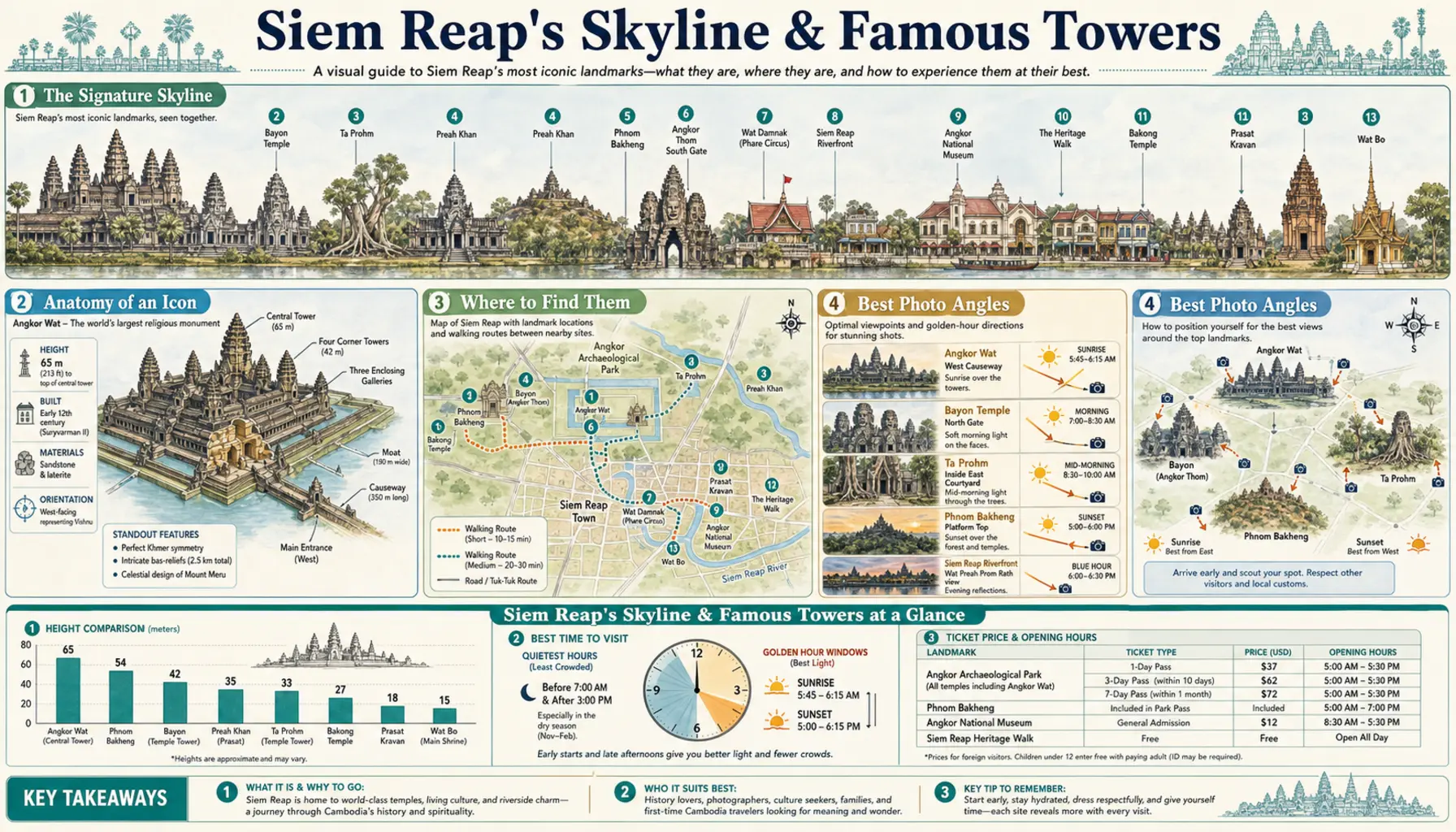
Siem Reap is one of the few Asian towns of its size with no high-rise silhouette at all, and that is by design: planning rules keep building heights low to protect sightlines across the park, so nothing competes with the profile on the national flag. What passes for a skyline here is sandstone. Angkor Wat's five lotus towers, set out as a quincunx, rise about 65 metres above the western causeway, and four kilometres north the Bayon stacks dozens of towers into a single mass of carved faces that reads differently at every hour of the day.
The towers themselves
Angkor Wat's central tower is the tallest of the five and is reached by a steep modern staircase on the upper level, where a dress code covering shoulders and knees is enforced. The Bayon, at the centre of Angkor Thom, carries around 200 serene faces across its towers, and late afternoon gives the deepest relief on them. For height without a queue, the pyramid temples work well: Pre Rup in laterite and Ta Keo in bare sandstone are both climbable, and both look out over unbroken forest canopy rather than rooftops. Phnom Bakheng, the sunset hill, limits numbers on its upper terrace, so arriving well before the light goes matters.
Views over the town and plain
The Angkor Balloon, tethered beside the road between town and the west gate, lifts a gondola a couple of hundred metres for roughly ten minutes and gives the clearest sense of how flat and green the plain is. Phnom Krom, a 140-metre hill about 12 km south on the road to the lake, is the best free viewpoint, taking in floodplain, fish farms and the Tonle Sap horizon; it is at its most dramatic when the water is high between September and November. In town, rooftop bars top out at four or five storeys, pleasant at dusk, though the view is palm crowns and tiled roofs rather than towers.