Street Food Guide in Siem Reap & Angkor Wat
A visual guide from the Siem Reap and Angkor Wat travel guide — see all posters in Visual Guides.
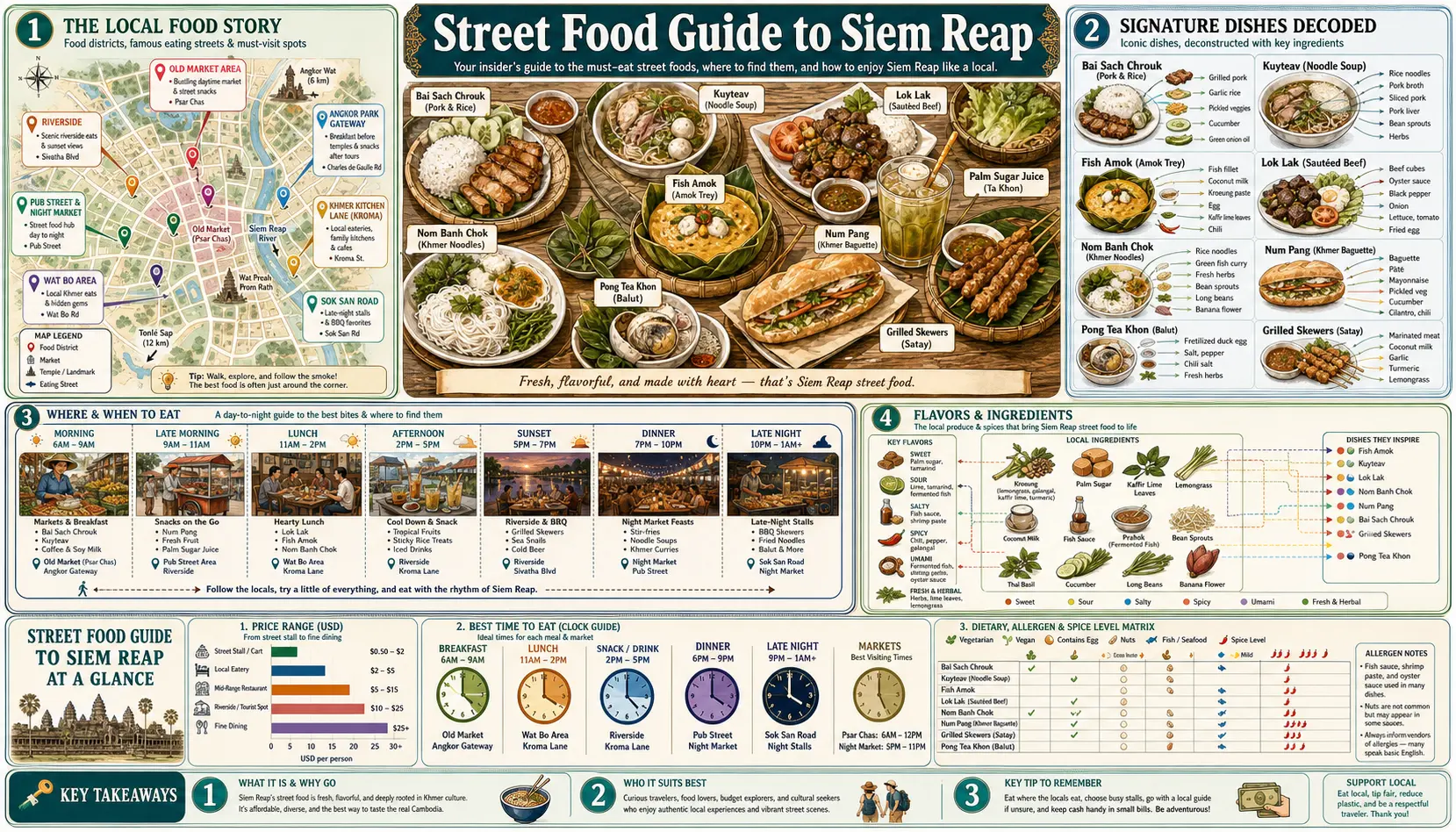
Breakfast in Siem Reap is settled by about seven in the morning, on a plastic stool beside a charcoal grill: bai sach chrouk, thin slices of pork marinated in coconut milk and garlic, grilled over embers and served on broken rice with pickled cucumber and a bowl of clear broth alongside. Around a dollar and a half, ten minutes, and the day starts properly. The other morning staple, nom banh chok, arrives from a basket slung on a shoulder pole, cold rice noodles under a green fish gravy with raw banana flower and water lily stem piled on top.
Where the stalls are
Road 60, the wide strip running north towards the Angkor ticket office, becomes a night market for Khmer families from about five: grilled skewers, whole tilapia packed in salt, fried noodles, fairground rides and very few foreign faces. Psar Chas has a hot food corner inside the market that runs from early morning to mid-afternoon. Psar Leu, east on National Road 6, is the biggest and roughest, and is best before nine. Around the river and the night markets off Sivatha, stalls sell num pang baguettes, fruit shakes and the fried crickets and tarantulas that come up from Skuon in Kampong Cham.
Ordering and eating well
Point at what is already cooking and already being eaten, because turnover is the most reliable hygiene test in any Cambodian market. Plates typically run one to three dollars and are quoted in dollars, with riel as change. Grilled and stir-fried items are the safe end; raw herbs, cut fruit and ice are fine at busy stalls and worth skipping at quiet ones. A few words help: ang for grilled, chha for stir-fried, ot hal for not spicy. Fish amok and lok lak are restaurant dishes rather than street food, so keep one evening for a sit-down Khmer kitchen instead.