Unmissable Experiences in Siem Reap & Angkor Wat
A visual guide from the Siem Reap and Angkor Wat travel guide — see all posters in Visual Guides.
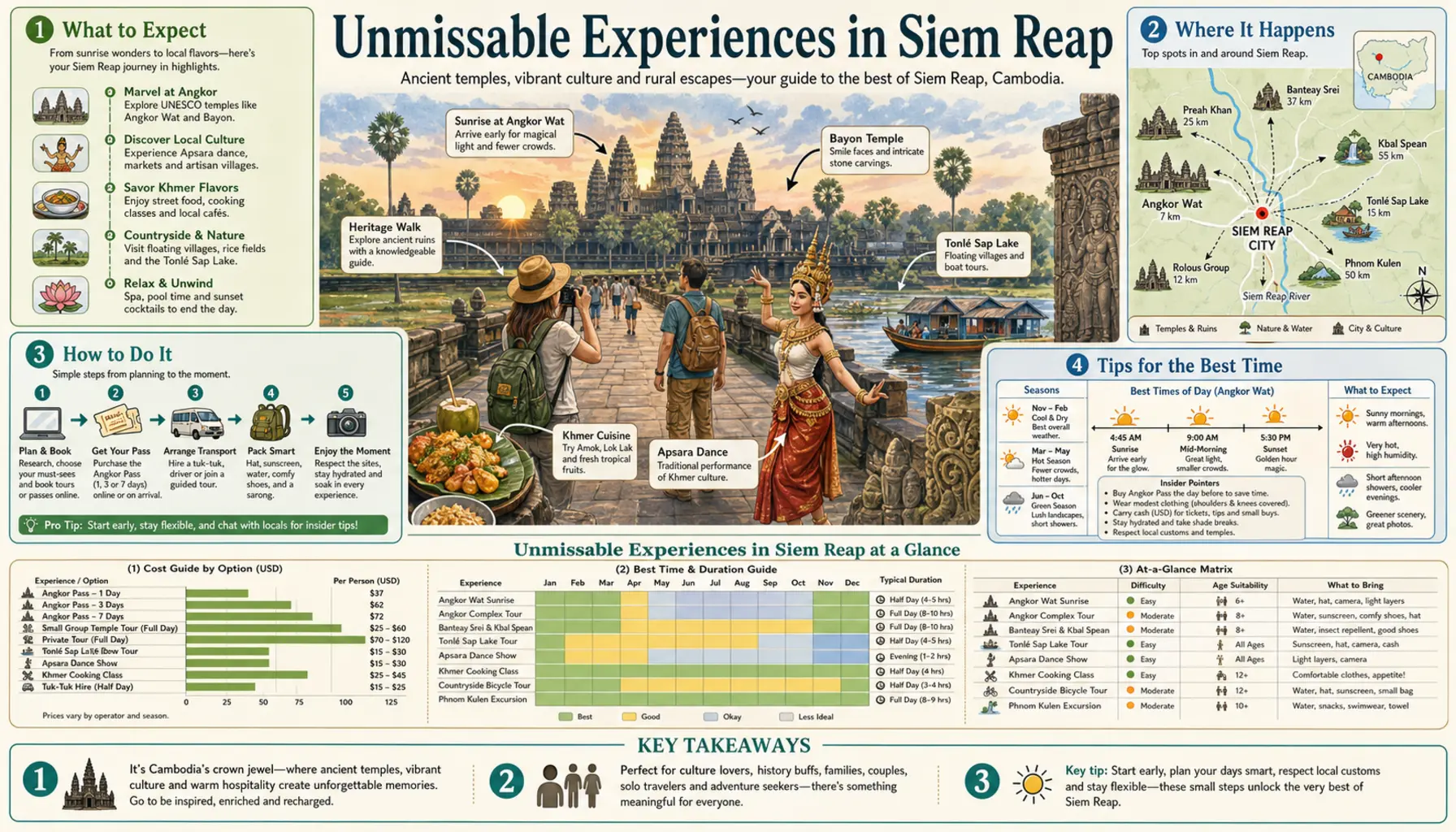
Almost everyone photographs the Angkor Wat sunrise from the left-hand pond, because that is where the crowd flows; the right-hand one, a hundred metres north, gives the same reflection with a fraction of the people and a slightly better angle on the towers. Small differences like that decide how Siem Reap feels. The temples reward specific hours rather than long days, the Bayon at four in the afternoon and Ta Prohm at opening, and the better evenings usually happen well away from them, at a circus tent or a night market full of Khmer families.
Inside the park
Aim to be at Angkor Wat by about 5.15am for sunrise and walk on to the northern reflecting pond. Ta Prohm, where silk-cotton roots grip the collapsed galleries, is at its best in the first hour after opening; by ten it is a shuffling queue. The Bayon's faces need low sun, so hold it back for late afternoon. Banteay Srei, 37 km north-east, justifies the drive for the sheer density of carving in its pink sandstone and looks best in morning light. With more time, Beng Mealea or Koh Ker show the unrestored version, with far fewer people and around two hours on the road each way.
Beyond the temples
Phare, the Cambodian Circus, performs nightly under a tent off Sok San Road and runs about seventy minutes, which leaves the evening intact for dinner afterwards. A boat from Kampong Phluk, roughly 30 km from town, into the flooded forest is at its most striking between September and November, when the water is high and the paddling happens between submerged trees. Road 60 after five is the local night market, with grilled fish, skewers and fairground rides. For a full day out, Phnom Kulen's waterfall and carved riverbed lie about 50 km north-east, while the West Baray offers an easier, much closer version of the same idea.