War and Resistance History in Siem Reap
A visual guide from the Siem Reap and Angkor Wat travel guide — see all posters in Visual Guides.
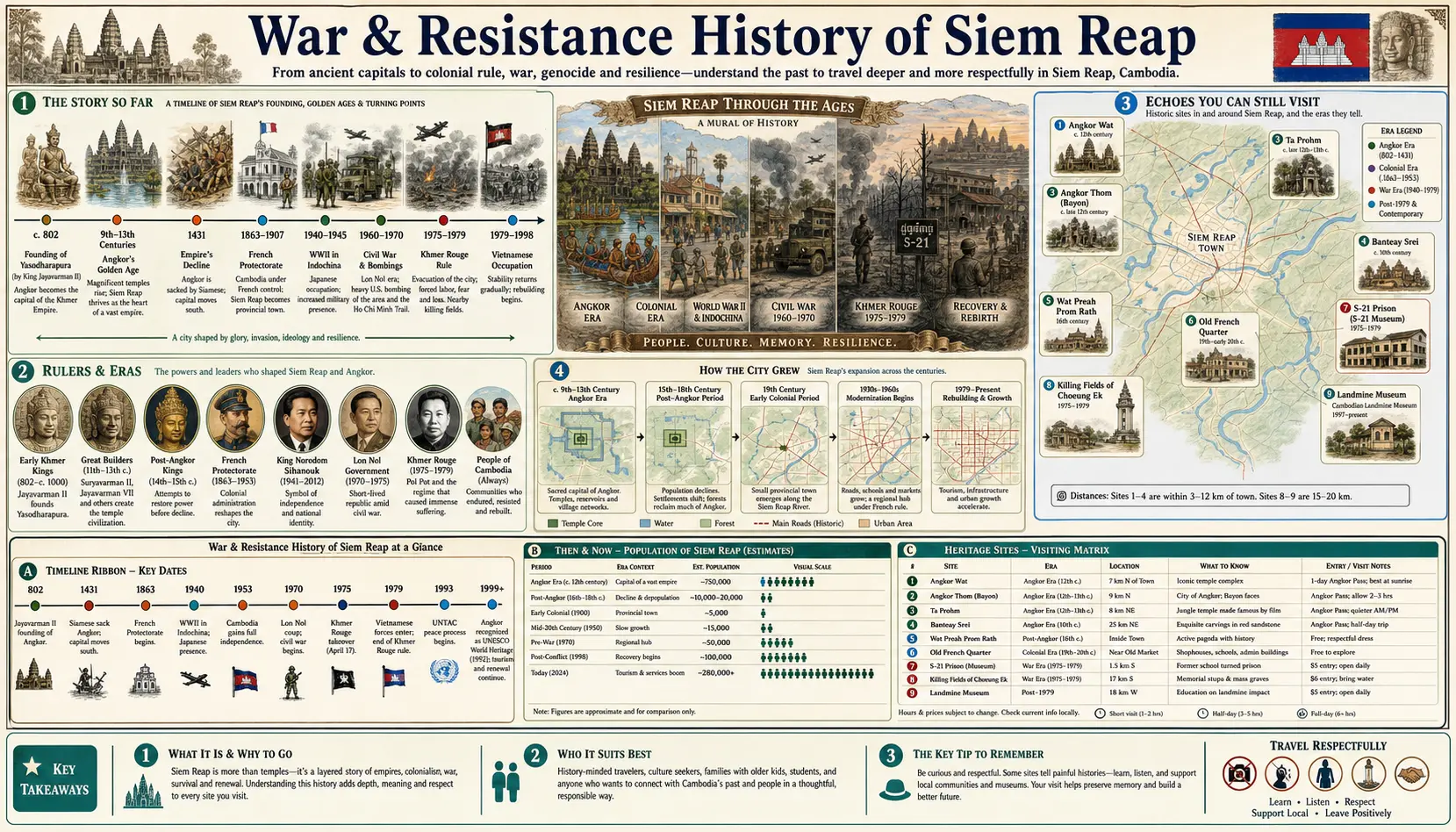
Parked in a field on the western edge of town, a Soviet-built tank sits with its hatches open and its armour peeled back where a mine went off — one of dozens of tanks, howitzers and grounded MiGs at the War Museum Cambodia, most of them left over from fighting that only really stopped in this province in the late 1990s. Siem Reap's war sites are scattered and deliberately low-key: an outdoor arms collection, a landmine museum out near Banteay Srei, a memorial stupa on the temple road, and a long drive north to the Khmer Rouge's last redoubt.
The sites in and near town
War Museum Cambodia, off the road toward the old airport, is an open-air yard of tanks, artillery and aircraft, and its guides are usually former soldiers who talk through their own service — the reason to go, rather than the hardware itself. Wat Thmey, about three kilometres up the road to the temples, holds a glass-sided memorial stupa of skulls and bones recovered from a Khmer Rouge site, and is quiet enough to visit properly. The Cambodia Landmine Museum, roughly 25 km north near Banteay Srei, was set up by a former child soldier turned deminer and doubles as a relief centre for affected children.
Demining, and the road to Anlong Veng
APOPO's visitor centre, out toward the Angkor ticket office, demonstrates the giant pouched rats trained to sniff out buried TNT — a short, genuinely interesting session on clearance work still running across the northwest. For the harder history, Anlong Veng lies about 125 km north on National Road 67, near the Thai border in the Dangrek range: Ta Mok's lakeside house, the escarpment lookouts and Pol Pot's unceremonious cremation site. Allow a full day with a driver, roughly three hours each way, and arrange a guide through the Anlong Veng Peace Center — the sites are barely marked and make little sense unaccompanied.