Ancient Ruins in Kyoto
A visual guide from the Kyoto travel guide — see all posters in Visual Guides.
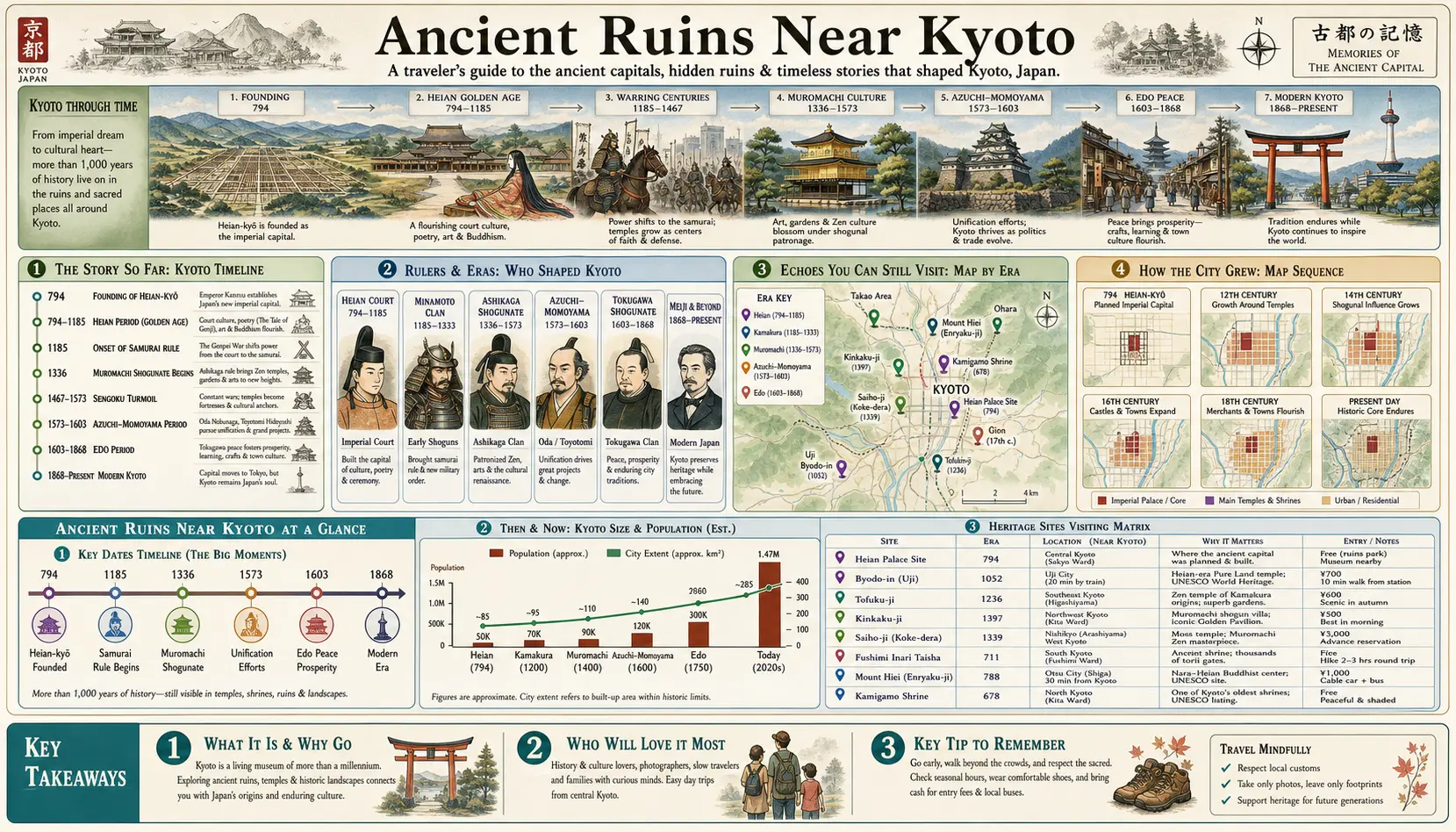
Kyoto keeps its ruins in plain sight and barely labels them. The great south gate of the Heian capital, the Rashomon of the film, is now a stone post in a small playground off Kujo-dori with swings beside it. The imperial palace that anchored the 794 grid stood well west of today's Imperial Park, and its throne hall survives as a monument on a residential corner. Reading the old city takes a map and some willingness to stand about in ordinary streets, but the outlines are all still there.
What actually survives
The Daigokuden site, where the Heian palace's great audience hall stood, is marked in a small park near Senbon-Marutamachi, and Senbon-dori itself follows the line of the old ceremonial avenue that ran south from it. Nijo Castle's original five-storey keep burned after a lightning strike in 1750 and was never rebuilt; the stone platform remains, and the steps up it give a clean view across the inner moat. Hideyoshi's Odoi, the earthen rampart thrown around the whole city in the 1590s, still reads as wooded banks in Kita ward and near Kyoto University.
Making sense of it
Start at the Heiankyo Sozokan near Marutamachi, where a large scale model of the eighth-century grid makes the geography click before you go hunting for stone markers in the street. From there the Senbon-dori sites are a short walk or one bus north. Fushimi Momoyama in the south is a different case: the keep you see is a 1960s concrete replica, and the genuine castle ground now lies inside an imperial tomb precinct closed to visitors. Allow half a day, expect low-key posts and information boards rather than standing walls, and treat the walking between them as the point.