Archaeological Treasures in Kyoto
A visual guide from the Kyoto travel guide — see all posters in Visual Guides.
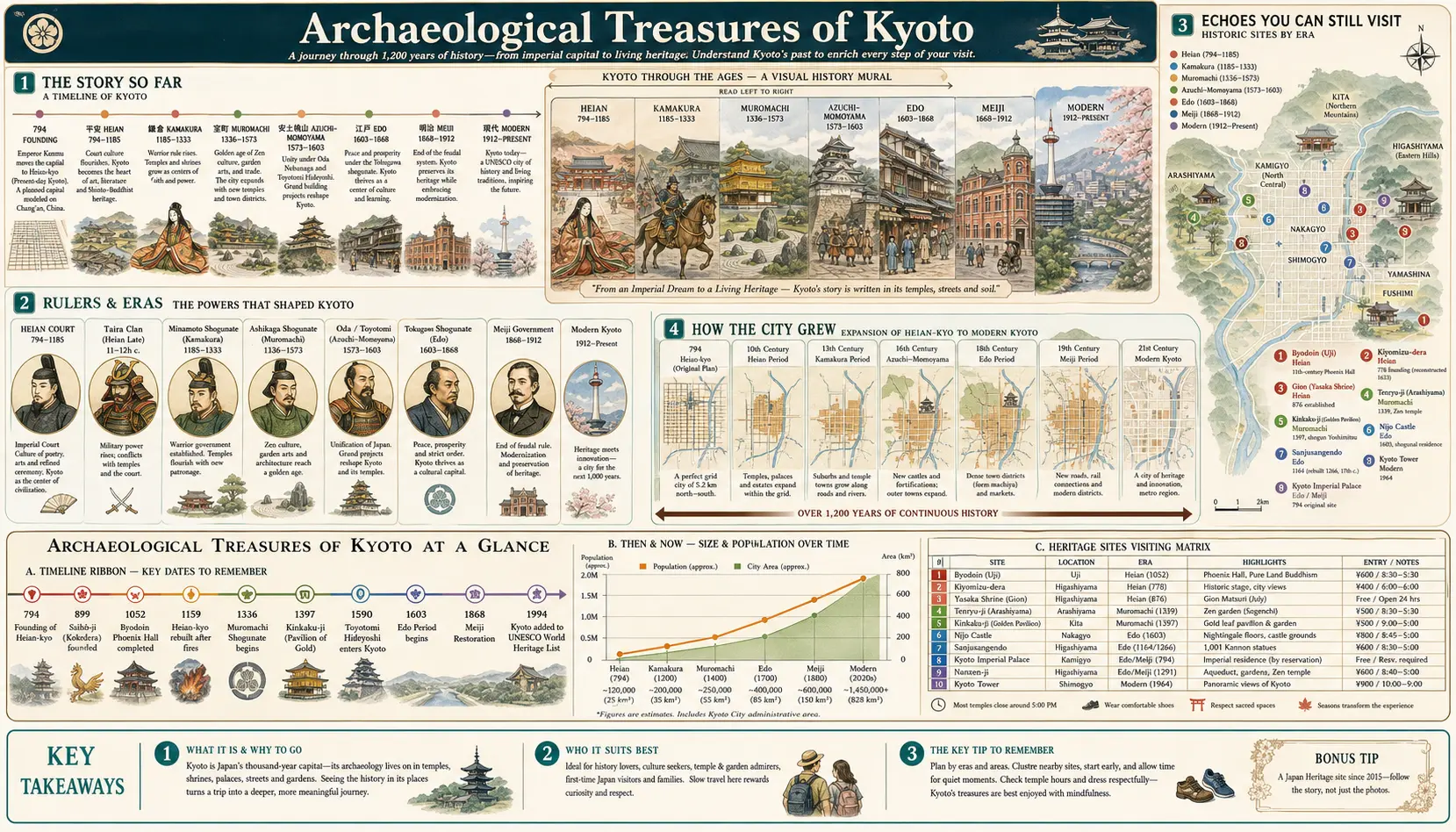
Under the Kyoto grid there is a metre or two of compressed history, and every time a car park goes in something comes up: Heian roof tiles, Chinese coins, ink-inscribed pottery, the occasional kiln. Much of it ends up in modest municipal display rooms rather than blockbuster galleries, which is why the best archaeological hour in the city is often free and almost empty. Out in the western suburbs the largest stone burial chamber in the prefecture still stands where its mound eroded off it, boxed in by ordinary houses on a quiet residential street.
Where the finds are shown
The Kyoto City Archaeological Museum near Imadegawa-Horikawa is the specialist stop, with cases of excavated Heian-kyo pottery, tiles and everyday metalwork, no admission charge at last check and rarely a queue. The Kyoto National Museum in Higashiyama holds the heavyweight material, split between Katayama Tokuma's 1895 brick hall and Yoshio Taniguchi's 2014 Heisei Chishinkan; rotations mean the archaeology cases change, so check what is on before making the trip. The Kyoto University Museum on the Yoshida campus adds Jomon and Yayoi collections and is usually the quietest of the three.
Getting out to the sites
The Muko and Nagaokakyo area southwest of the city served as the capital for a decade before Kyoto did, and it has the field archaeology to match. Mozume Kurumazuka in Muko is a sixth-century keyhole tomb kept as a small public site, added in 2016 to the nationally listed Otokuni kofun group and roughly twenty-five minutes out on the Hankyu Kyoto line plus a walk through housing; the stone chamber itself is normally closed. Closer in at Uzumasa, Hebizuka Kofun has the largest chamber in the prefecture, its megaliths left exposed where the mound wore away, about seven minutes from Katabiranotsuji on the Randen — fenced and locked, with Kyoto City taking viewing requests through an online form. The Yamashiro plain further south produced the bronze-mirror hoards that shaped Japanese archaeology. Signage is largely in Japanese, so save a map offline.