Art Galleries and Creative Spaces in Kyoto
A visual guide from the Kyoto travel guide — see all posters in Visual Guides.
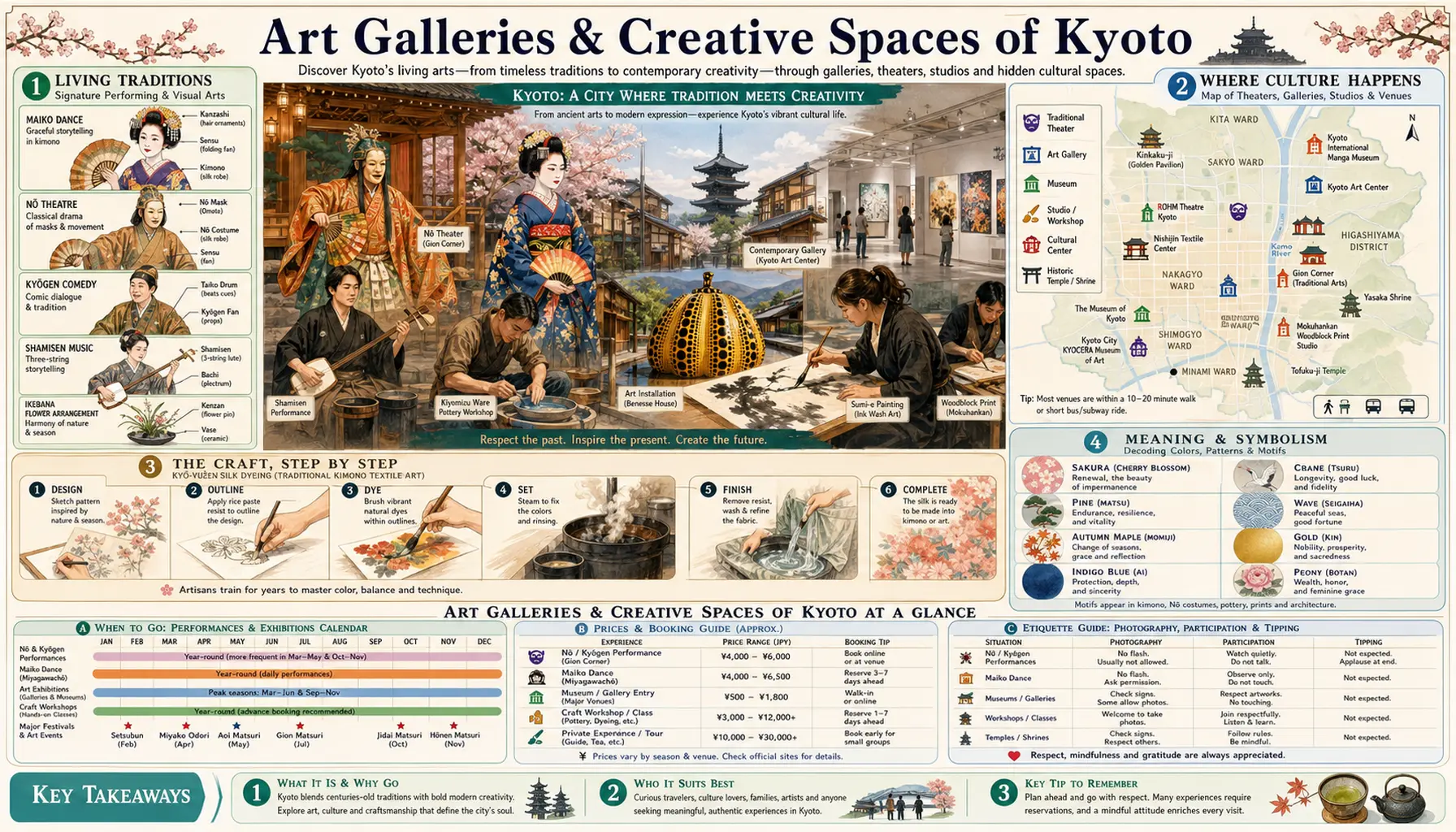
Okazaki does the heavy lifting. The Kyoto City Kyocera Museum of Art kept its 1933 tiled roof and had a sunken glass entrance slid underneath it in the 2020 rebuild, so you now walk down into a modern lobby beneath an eighty-year-old facade, with the National Museum of Modern Art directly opposite and a giant vermilion torii framing the whole axis. A few minutes west, a 1930s primary school has become the Kyoto Art Center, and each spring photography spills out of galleries into machiya and warehouses across the city.
The core circuit
Okazaki packs four venues into ten minutes of walking: the Kyocera Museum, whose free ground-floor Triangle space shows younger artists and whose roof terrace looks back down the torii axis; MoMAK opposite, strong on Japanese modernism and crafts; the Kyoto Prefectural Library behind its preserved 1909 facade; and ROHM Theatre Kyoto, Kunio Maekawa's 1960 concert hall, reopened in 2016 with a bookshop and courtyard cafe worth an hour on their own. Take the Tozai subway to Higashiyama and walk north, or follow the canal up from Sanjo in about fifteen minutes.
Beyond the museums
The Kyoto Art Center occupies the former Meirin Elementary School in Nakagyo, with wooden corridors, free galleries, resident artists and a coffee shop in an old classroom. The Kyoto International Manga Museum, in another 1929 school building, lets you pull any of tens of thousands of volumes off the shelves and read on the lawn. Fukuda Art Museum in Arashiyama, opened in 2019, pairs Japanese painting with a full-width window onto the Katsura River. Time a spring visit with Kyotographie, the international photography festival that typically runs across April and May in borrowed buildings citywide.