Best Food Markets in Kyoto
A visual guide from the Kyoto travel guide — see all posters in Visual Guides.
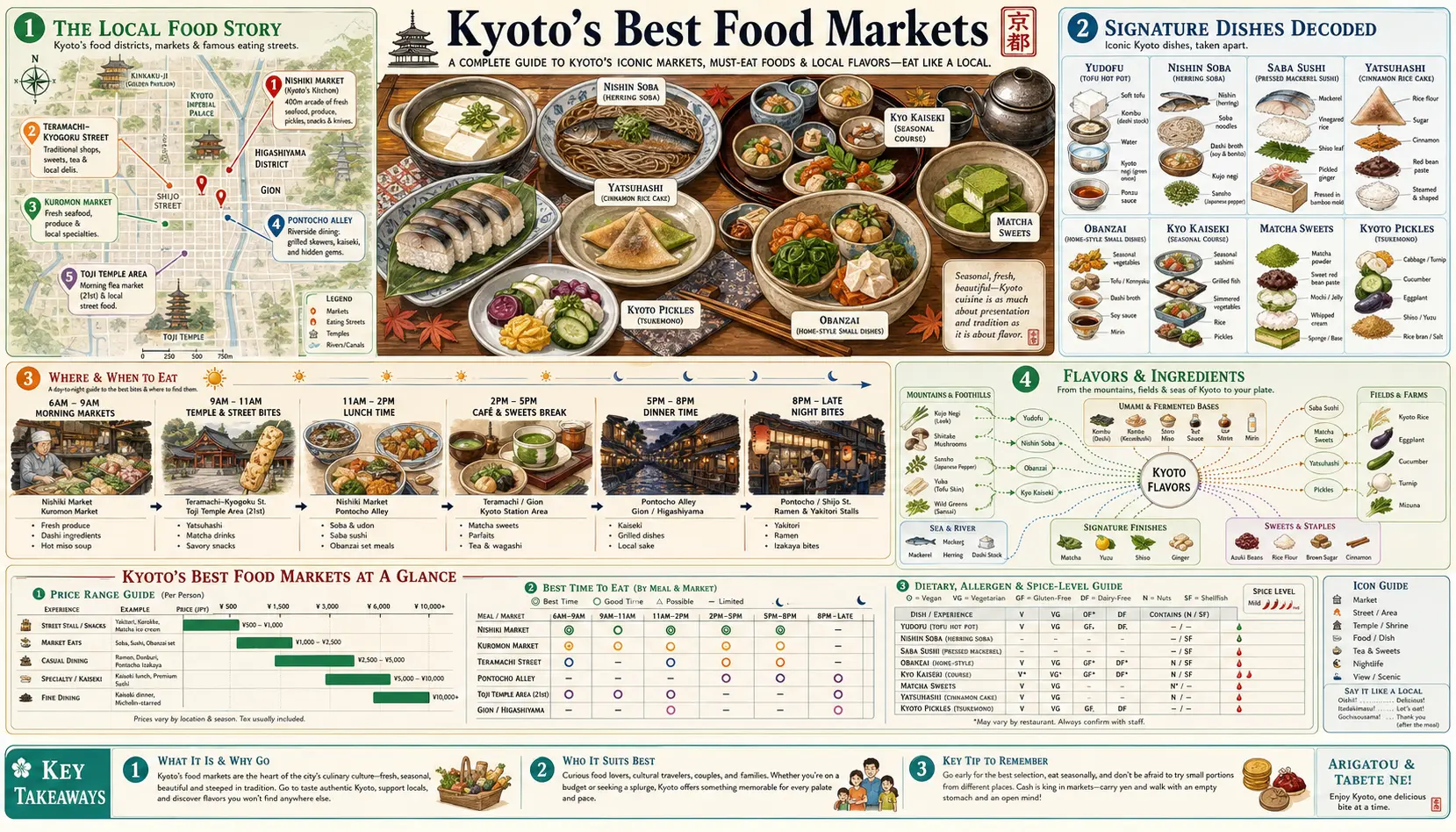
Nishiki Market is four hundred metres of covered arcade one block north of Shijo, and at eight in the morning it belongs to chefs and the people who supply them: tubs of pickles being turned, dashi going into flasks, knives being sharpened at Aritsugu, a bladesmith trading in Kyoto since the sixteenth century and now sitting at the Gokomachi end. By eleven it is shoulder to shoulder and the character changes entirely. Kyoto's other food markets are quieter and, in the case of the department-store basements, arguably better value.
Nishiki, done properly
Enter from the Teramachi end and walk west, allowing about an hour. Standouts include tako tamago, a small octopus with a quail egg set into the head, along with soy-milk doughnuts, fresh yuba, dashimaki tamago rolled to order, and pickle shops that will let you taste before buying. Eating while walking is discouraged now, and most stalls have a counter or step where you are meant to stand and finish. Go before ten for photographs or conversation. Some shops close on Wednesdays and many shut by late afternoon, so this is not an evening plan.
Where locals actually shop
The basement food halls under Daimaru and Takashimaya on Shijo are the best single-roof food shopping in the city, covering bento, wagashi, grilled fish and prepared dishes, with steep discounts in the last hour before closing. Demachi Masugata, a short arcade near Demachiyanagi station, is an ordinary neighbourhood market with an extraordinary queue outside Demachi Futaba for its bean mochi. Sanjo-kai on the west side is long, cheap and entirely local. For sheer scale, the Kyoto Central Wholesale Market near Tambaguchi has run since 1927 and periodically opens parts of its site to the public.