Best Time to Visit Kyoto
A visual guide from the Kyoto travel guide — see all posters in Visual Guides.
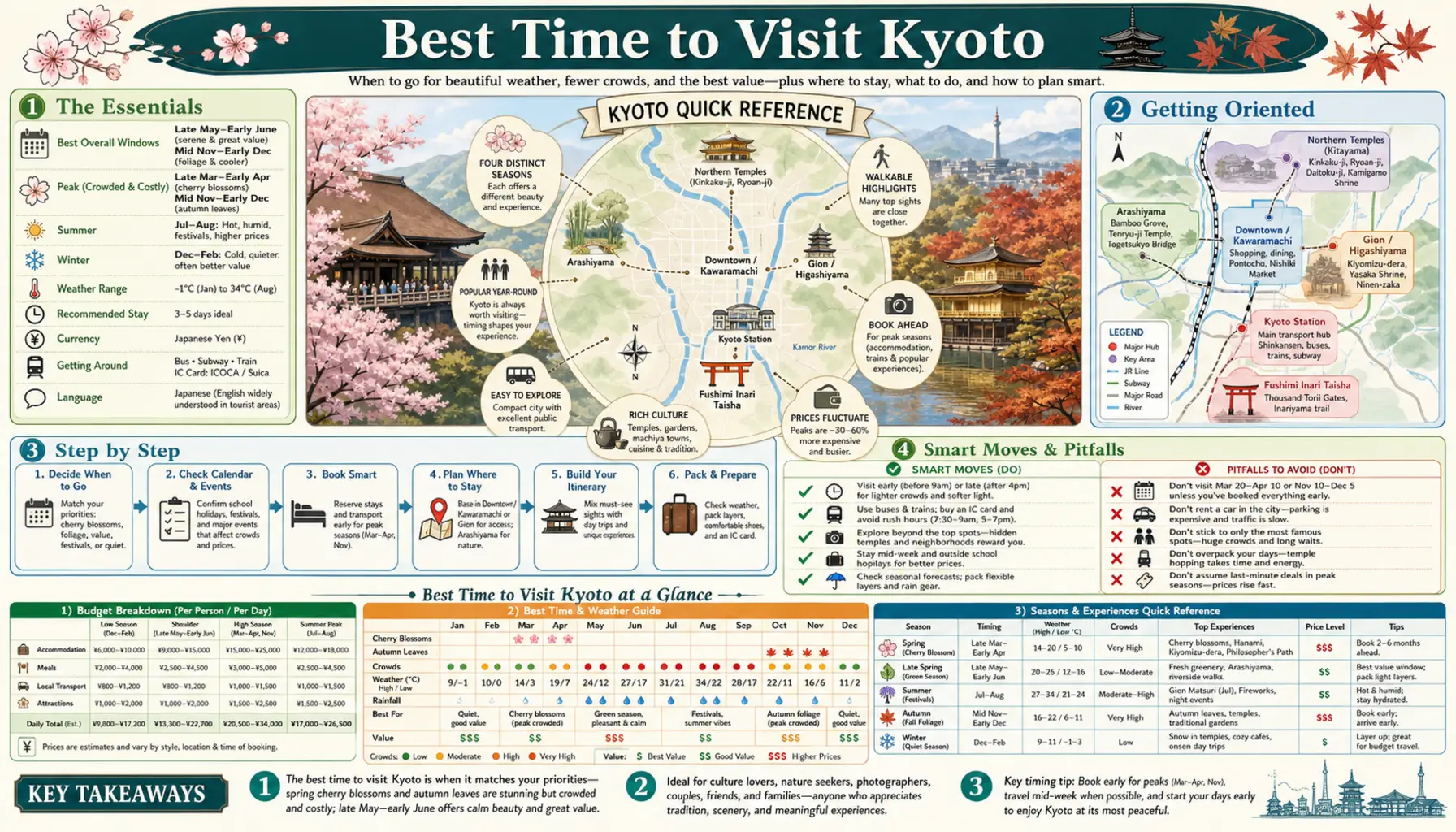
Kyoto's calendar has two spikes and everybody knows it. Cherry blossom usually peaks in the first week of April, and the maples usually turn in the third week of November. In both windows hotel rates roughly double, the bridge at Tofuku-ji develops a queue, and the eight o'clock start becomes non-negotiable. What the spikes hide is that mid-May and early December are close to ideal — green or bare, but warm enough, half-empty and cheap — and that a snowy January morning is one of the best things the city does.
Season by season
Spring opens with plums in late February and runs to cherries, usually late March into early April, with the Keage Incline, the Kamo riverbanks and the Botanical Garden's Nakaragi path as the reliable spots. Summer is genuinely hard, because the basin traps heat and July and August regularly reach the mid-thirties, with a rainy season typically from mid-June into July; it also brings Gion Matsuri in July and dining decks over the Kamo and up at Kibune. Autumn colour starts at Takao in early November and reaches central Kyoto around the twentieth. Winter is cold, clear and quiet.
Working around the crowds
The peaks are not only international. Golden Week in late April and early May, and Obon in mid-August, fill the city with domestic travellers and push transport and room prices up sharply. In blossom and maple season, reach the headline sites by eight and save the afternoon for neighbourhoods such as Nishijin, Fushimi or the Kamo delta, which never really get busy. Book April and November accommodation several months ahead. If dates are flexible, aim for the second half of May, mid-September once the heat breaks, or the first fortnight of December.