Floating and Specialty Markets in Kyoto
A visual guide from the Kyoto travel guide — see all posters in Visual Guides.
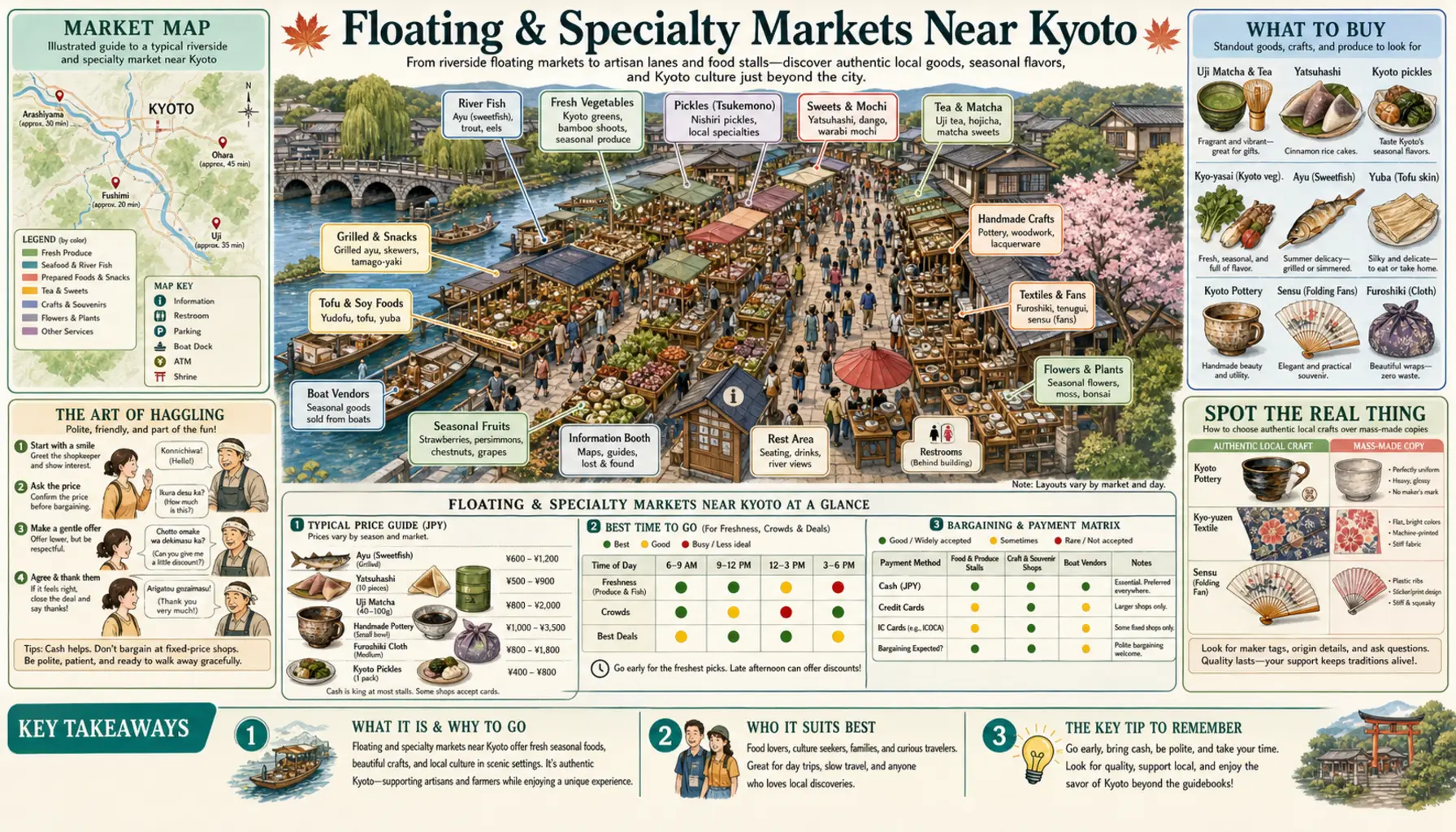
Kyoto's version of a floating market is a single wooden skiff that motors out to meet the Hozugawa boats near the end of their run down the gorge, ties on alongside and sells grilled squid, dango and cold drinks over the gunwale while both craft drift towards Arashiyama. Ashore, the city's specialty trading happens on fixed dates rather than on water: two enormous temple fairs each month, a covered food arcade running four hundred metres through the centre, and a handful of smaller handmade craft markets.
The monthly fairs
Kobo-san fills the grounds of To-ji, about fifteen minutes' walk south-west of Kyoto Station, on the 21st of each month with something like a thousand stalls — old kimono sold by weight, tools, ceramics, pickles and plants — and starts thinning by early afternoon. Tenjin-san does much the same at Kitano Tenmangu on the 25th, with a stronger antiques and textile bias. The Chion-ji handmade market near Hyakumanben, usually the 15th, is smaller and skews towards younger makers. The December editions of both big fairs are the busiest of the year.
Nishiki and the river
Nishiki Market runs a narrow, roofed four hundred metres between Teramachi and Takakura, one block north of Shijo: pickle barrels, tofu skin, knife makers such as Aritsugu, and a lot of skewered food best eaten standing still rather than walking. Mornings are calmer than afternoons. For the water side, the Hozugawa boats leave Kameoka, about half an hour from Kyoto by JR, and take roughly two hours down to Arashiyama; from May to September the restaurants along the Kamo River build their yuka platforms out over the water for open-air dinners.