Free Things to Do in Kyoto
A visual guide from the Kyoto travel guide — see all posters in Visual Guides.
At the fork where the Takano and Kamo rivers meet below Demachiyanagi, a line of concrete stepping stones — some cut as turtles, some as plovers — crosses the shallows, and on any warm evening the grassy banks fill with students, buskers and people eating convenience-store dinners. It costs nothing, and a surprising amount of Kyoto works the same way. The paid attractions here are mostly temple interiors and gardens; the streets, riversides, viewpoints and one very good railway station are open to anyone.
Walks and viewpoints
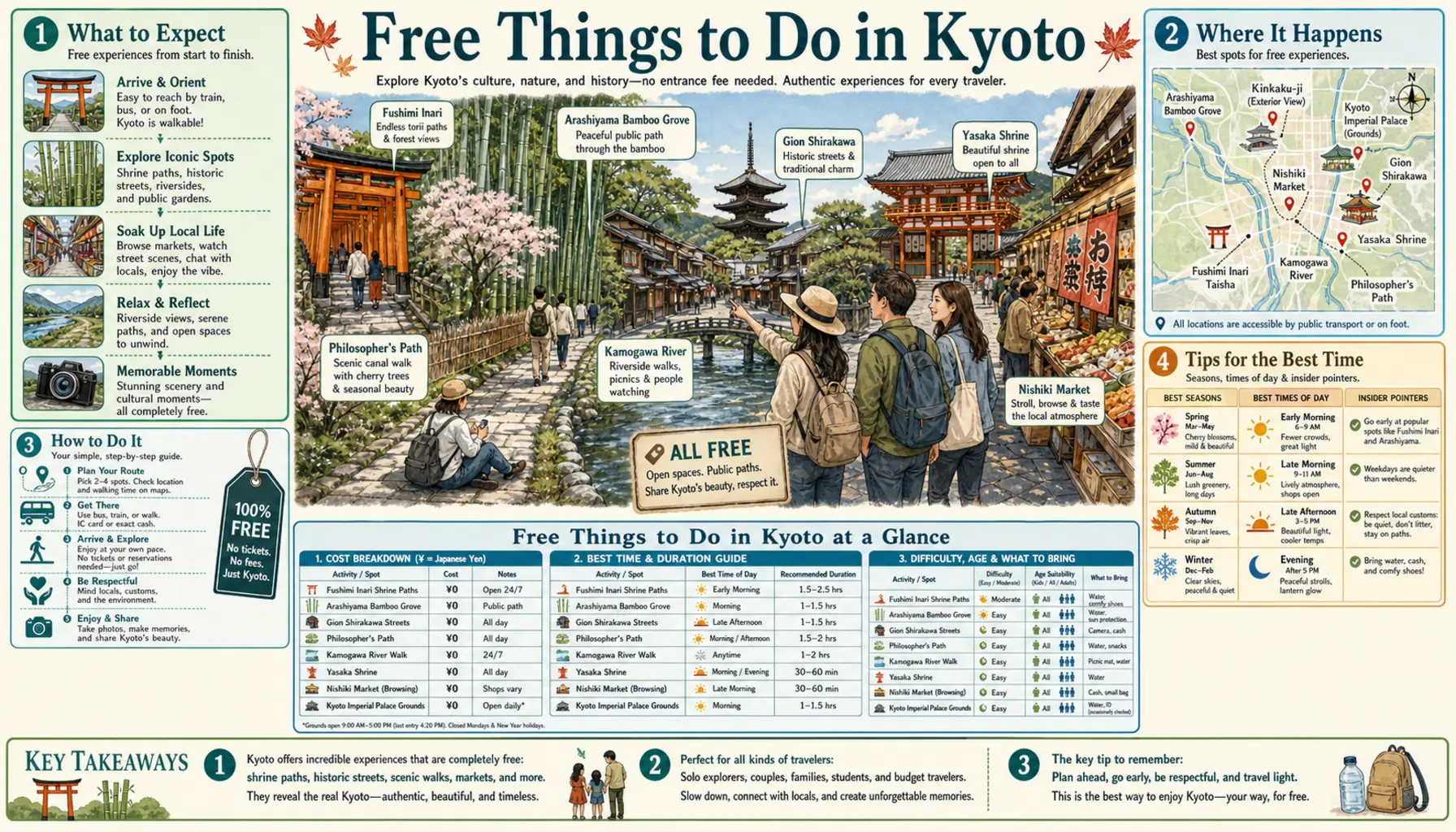
The Philosopher's Path traces a canal for roughly two kilometres between Ginkaku-ji and Nanzen-ji, and the brick Suirokaku aqueduct at the southern end, part of the 1890 Lake Biwa Canal, can be walked under at no charge. Above it, the disused rails of the Keage Incline climb through cherry trees. For a view, the Daimonji hike starts near Ginkaku-ji and reaches the bonfire clearing in about forty-five minutes, with the whole basin laid out below. Kyoto Gyoen, the walled park around the old Imperial Palace, is open gravel and pine and rarely crowded.
In the centre
Kyoto Station's own building repays half an hour: the 171-step Grand Staircase, the Skyway walkway strung across the atrium, and a rooftop garden terrace, all free. Nishiki Market costs nothing to walk, and the basement food halls at Daimaru and Takashimaya on Shijo are free to browse for the lacquered wagashi counters and whole-tuna breakdowns, with tasting samples on some days and not others. Fushimi Inari's torii tunnels are open around the clock at no charge; arriving at seven in the morning or after dark is the difference between a corridor and a crush. The Gion Shirakawa canal lanes are best just after sunset.