Literature and Storytelling Heritage in Kyoto
A visual guide from the Kyoto travel guide — see all posters in Visual Guides.
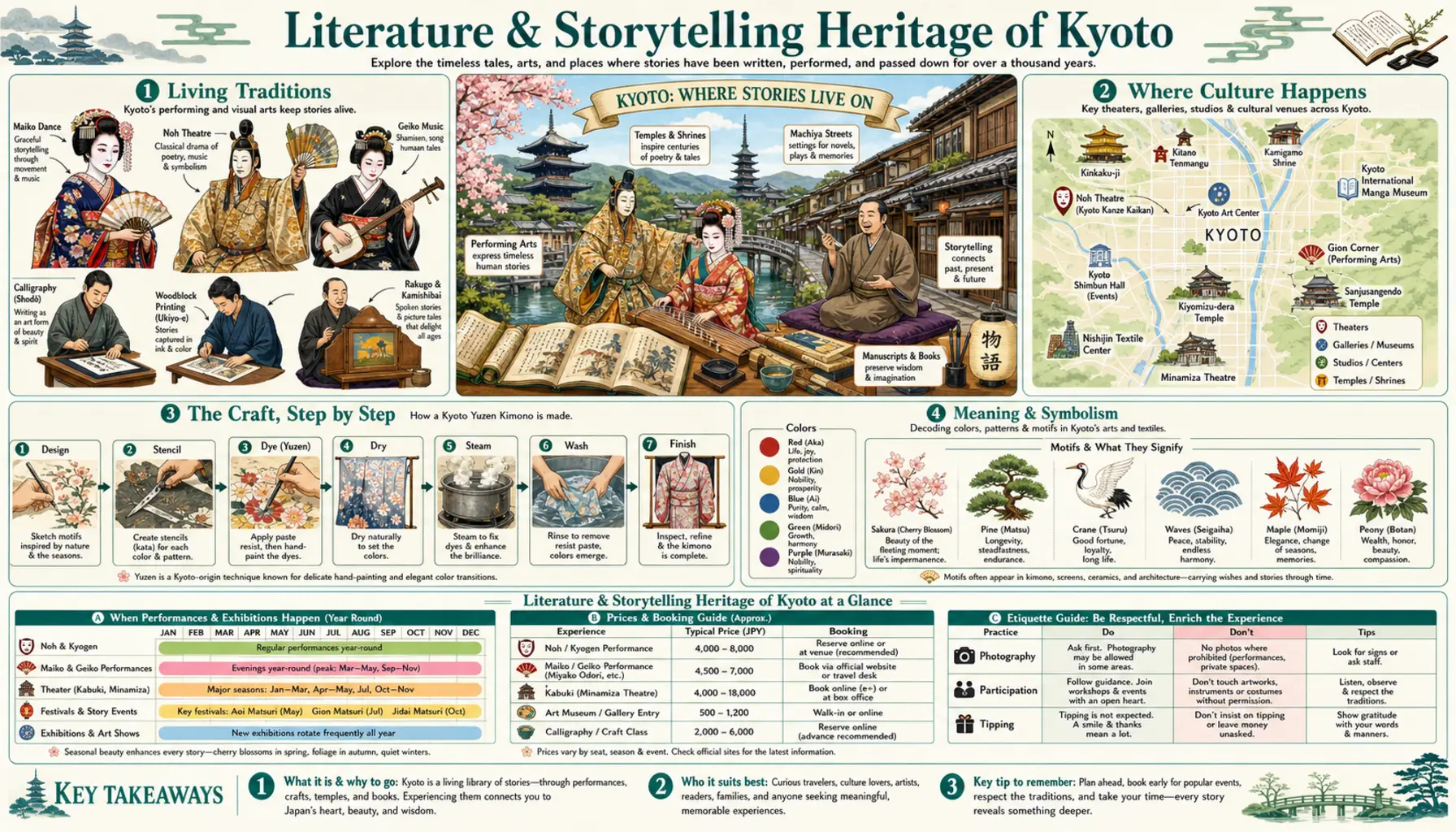
Readers still leave a lemon on the display tables at Maruzen on Kawaramachi, a century after Kajii Motojiro's short story had a nervous young man set one down on a stack of art books and walk out imagining it as a bomb. Kyoto carries that kind of literary residue everywhere: the world's first novel was written by a court lady here around 1008, and the city has been supplying settings to Japanese fiction — and more recently to manga and animation studios — ever since.
The classic layer
Murasaki Shikibu wrote The Tale of Genji at the Heian court, and its final ten chapters are set in Uji, where the Tale of Genji Museum near the station reconstructs the interiors and the riverbank walk takes about twenty minutes. Sei Shonagon's Pillow Book comes from the same generation and the same palace. Kamo no Chomei's Hojoki, written after he gave up on the city for a hut in the hills, has a replica of that hut at Kawai Shrine in the Tadasu-no-Mori woods. Rozan-ji on Teramachi marks the site of Murasaki's family home.
Modern pages
Mishima's The Temple of the Golden Pavilion took the 1950 burning of Kinkaku-ji as its subject; Kawabata's The Old Capital moves between Gion and the cedar plantations of Kitayama, both still recognisable on the ground. The Kyoto International Manga Museum at Karasuma-Oike keeps tens of thousands of volumes on open shelves inside a converted 1869 school, with a lawn to read them on. Keibunsha in Ichijoji, on the Eizan line, is a small and fiercely curated bookshop worth the trip north, and Café Bibliotic Hello near Nijo lets a coffee run long.