Modern Architectural Marvels in Kyoto
A visual guide from the Kyoto travel guide — see all posters in Visual Guides.
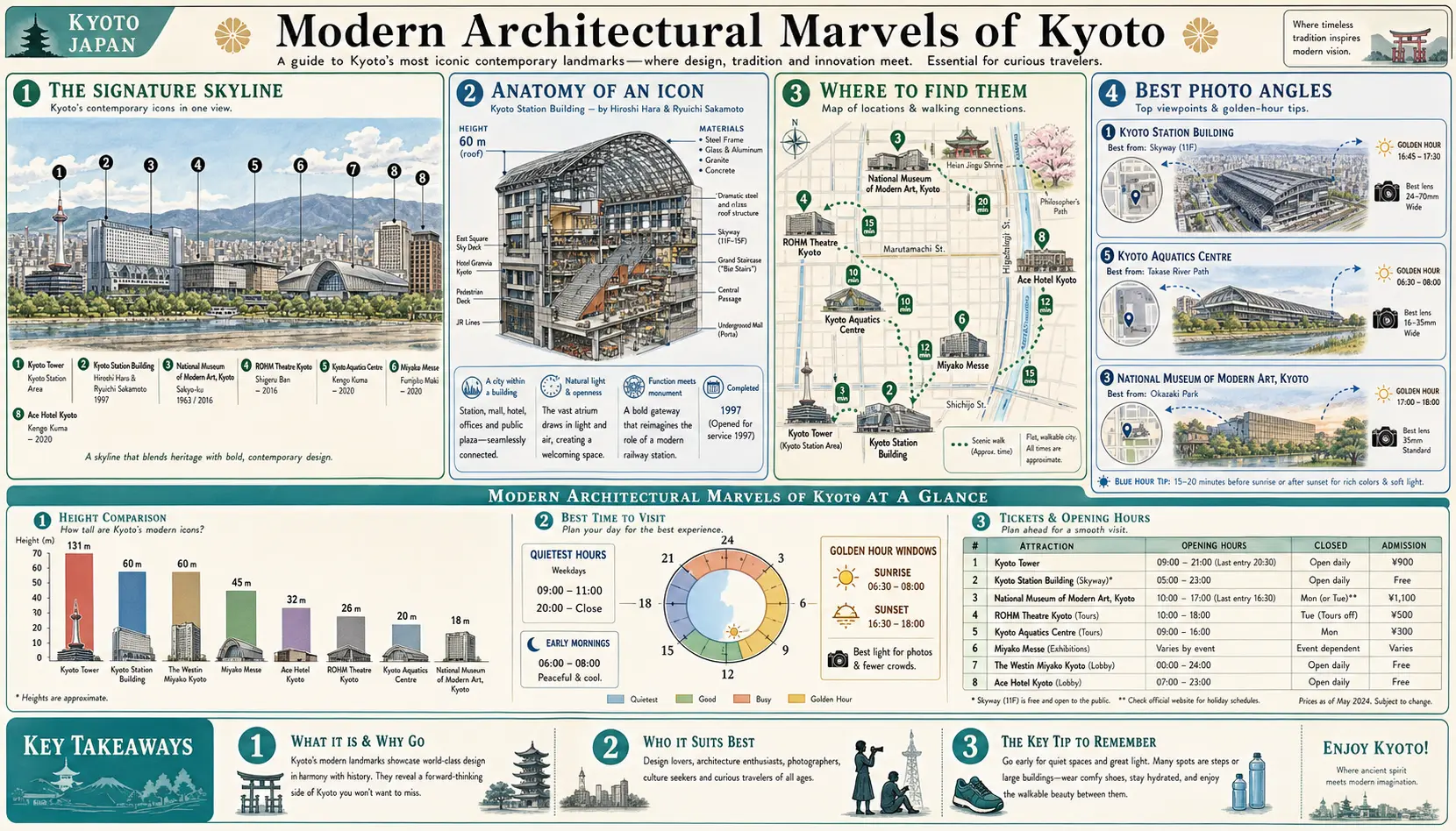
Hiroshi Hara's Kyoto Station opened in 1997 to genuine local fury: a 470-metre steel and glass canyon dropped into a city that had spent a century keeping its rooflines low. Nearly thirty years on it is the best free architecture in Kyoto — a 171-step staircase climbing into open air, a walkway strung across the void high above the concourse, and a rooftop garden with the hills on three sides. The rest of the modern city is quieter but no less deliberate, largely because the building code makes shouting illegal.
The buildings
Tadao Ando has several works worth the detour: Times, a small concrete retail block stepping down to the Takase canal at Sanjo, and the Garden of Fine Arts near Kitayama station, a sunken open-air gallery of ceramic reproductions crossed by ramps and waterfalls. Arata Isozaki's Kyoto Concert Hall sits on the same northern boulevard. Sachio Otani's 1966 International Conference Center at Kokusaikaikan is heroic trapezoidal concrete. Kengo Kuma wrapped the Ace Hotel around the 1926 Kyoto Central Telephone Office at Shin-Puh-Kan, and Jun Aoki slid a glass entrance beneath the 1933 Kyocera Museum of Art at Okazaki.
Why Kyoto looks like this
A townscape ordinance introduced in 2007 capped most central buildings at around 31 metres, cut the limit much lower in historic districts, banned rooftop signage and pushed chain logos into muted colours — which is why the convenience stores here are brown and the skyline carries no towers. The effect is that modern work has to be good rather than tall. Kyoto Tower, 131 metres and finished in 1964, predates the rules and remains the exception; its observation deck gives the clearest sense of how flat and how green the basin actually is.