Must-Try Local Dishes in Kyoto
A visual guide from the Kyoto travel guide — see all posters in Visual Guides.
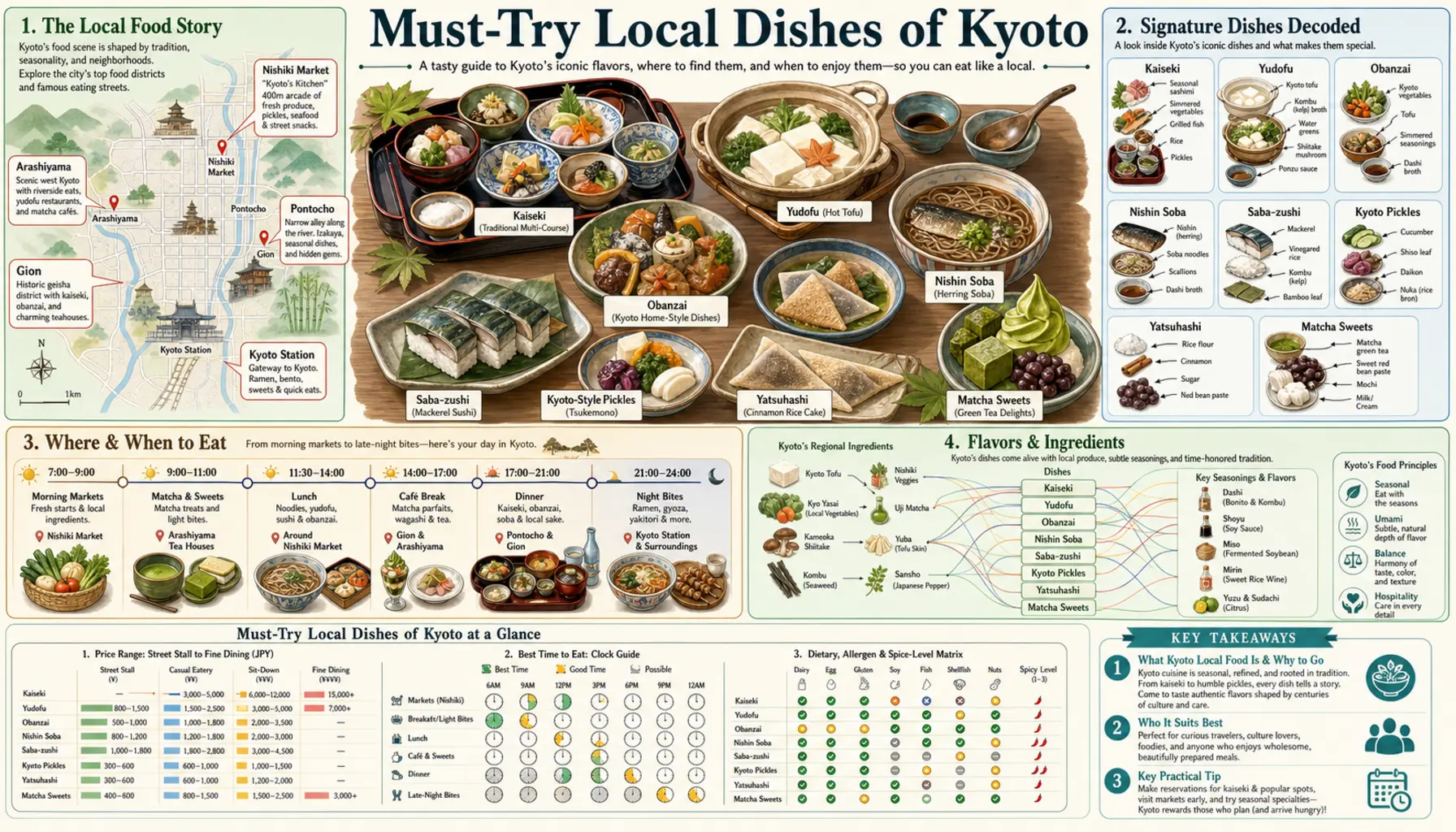
Kyoto cooking grew up a long way from the sea, on well water, mountain vegetables and soy, and it still tastes that way: pale dashi, restrained salt, tofu that arrives as the point of the meal rather than a side. The counterweight is a genuinely heavy ramen culture and a student city's appetite for it. A good day here runs from a bowl of nishin soba near the Kamo river to a tray of obanzai home-style dishes in a townhouse off Karasuma, with matcha somewhere in between.
The dishes to look for
Yudofu — blocks of tofu simmered in kombu broth — is the signature, best eaten at the old restaurants around Nanzenji and Arashiyama where it comes as a set with yuba, tempura and pickles. Nishin soba pairs buckwheat noodles with a sweet-simmered herring fillet; Matsuba beside the Minamiza theatre on Shijo is the traditional address. Saba-zushi, pressed mackerel sushi wrapped in kelp, is a Kyoto invention worth trying at Izuu in Gion. Add obanzai — small seasonal plates of kyo-yasai vegetables like kamo aubergine and kujo spring onion — and warabimochi or yatsuhashi for something sweet.
Where to eat cheaply and well
Nishiki Market, the covered lane one block north of Shijo, is the obvious grazing run — rolled dashi omelette, soy-milk doughnuts, skewered octopus, pickles by the tub — though it gets shoulder-to-shoulder by late morning, so before ten is the sensible slot. For ramen, the Eizan line north to Ichijoji reaches a student stretch with a dozen serious shops trading in thick pork-back-fat broths; queues of twenty minutes are normal. Near Kyoto Station, Honke Daiichi Asahi has served the darker soy-based Kyoto style for decades. Expect a bowl to cost roughly what a coffee and a pastry would back home.