Nightlife and Live Music in Kyoto
A visual guide from the Kyoto travel guide — see all posters in Visual Guides.
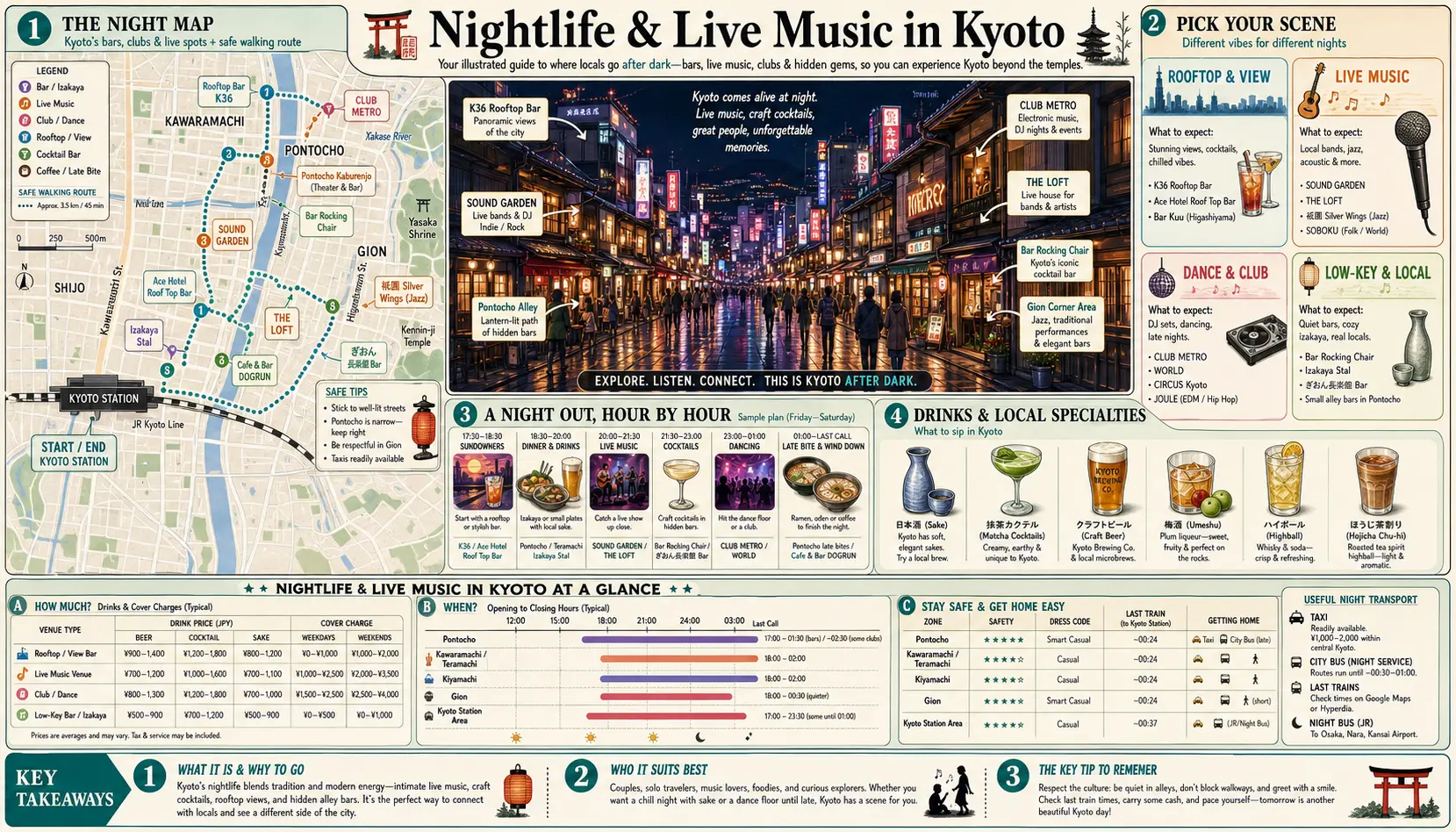
Kyoto's night runs along water. Kiyamachi-dori follows the narrow Takase canal for a kilometre between Gojo and Sanjo, and almost every doorway on it is a bar, a live house or a stairwell with four floors of them stacked above. One street east, Pontocho is the quieter, prettier lane of lantern-lit restaurants; one street west, Kawaramachi carries the noise. With three big universities in town the crowd skews young, and the music scene is far better than a city of 1.4 million normally supports.
Live houses and clubs
Kyoto Muse on Kiyamachi is the workhorse mid-size room for touring Japanese guitar bands. Takutaku, south towards Gojo, occupies a converted sake warehouse and has been booking blues, punk and folk since the 1970s. Urbanguild, a few floors up on Kiyamachi, leans experimental — improvised sets, noise, butoh. For dancing, Metro sits literally beneath an exit of Jingu-Marutamachi station on the Keihan line and has run techno and drag nights for over three decades, while World on Shijo-Kiyamachi is the larger, more mainstream club. Le Club Jazz near Sanjo covers the live jazz end. Cover charges are usually modest and often include a drink.
Bars and getting home
For drinking rather than gigs, the craft-beer strip is scattered: Kyoto Beer Lab sits on the Takase canal near Shichijo, Bungalow anchors the Shijo-Omiya corner with a standing ground floor, and small taprooms cluster around Nijo. Kyoto's cocktail bars are quietly excellent and often tiny — Bar Rocking Chair in Shimogyo is the best known. The practical catch is transport: the Karasuma and Tozai subways stop running somewhere around midnight, as do most buses, so the choice is finishing by 23:30, walking back along the Kamo, or budgeting for a taxi, which is easy to flag on Kawaramachi.