Parks and Green Spaces in Kyoto
A visual guide from the Kyoto travel guide — see all posters in Visual Guides.
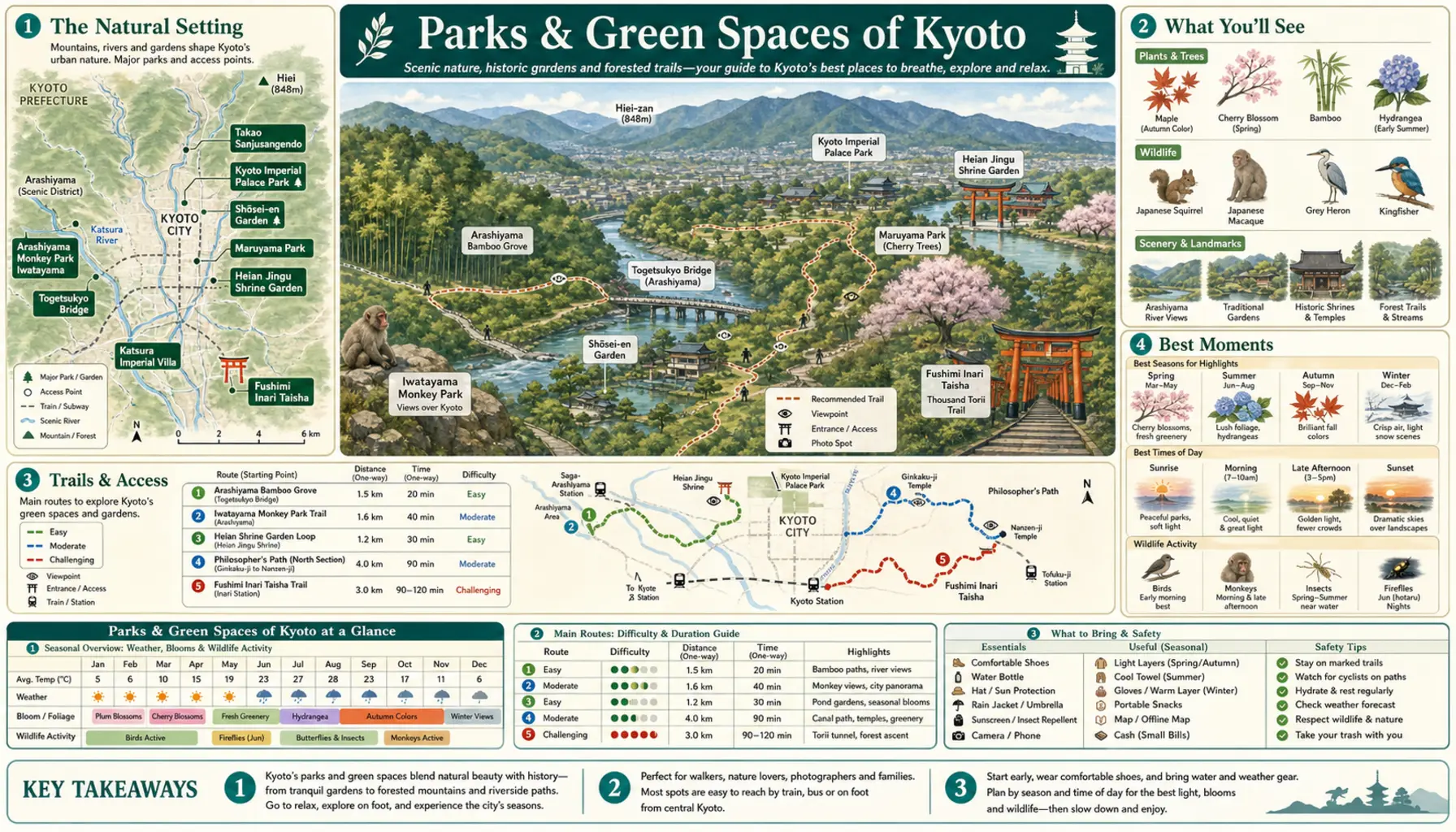
At the Kamogawa Delta in Demachiyanagi, where the Takano and Kamo rivers meet in a shallow V, concrete stepping stones shaped like turtles and plovers cross the water, and on any warm evening students are strung out along the grass banks with convenience-store beer and a guitar. It is the most-used green space in Kyoto and costs nothing. The city's parks work like that generally — open, unfenced, treated as everyday rooms rather than attractions, and mostly free, which is a relief in a city where the famous gardens all charge.
In the centre
Kyoto Gyoen, the old imperial park, is the biggest open space downtown: wide gravel avenues under pines, a plum grove that flowers in late February and a weeping cherry near the Konoe site in early April. Marutamachi and Imadegawa stations on the Karasuma subway sit at either end. Maruyama Park, behind Yasaka Shrine in Gion, is small but holds the city's most famous weeping cherry and turns into a food-stall party in blossom week. Near Kyoto Station, Umekoji Park gives a proper lawn, a small aquarium and the Kyoto Railway Museum, with its own JR station on the Sagano line.
Out towards the hills
North of the centre, the Kyoto Botanical Gardens opened in 1924 and still hold the best plant collection in western Japan, including a long conservatory of tropical species — Kitayama station on the Karasuma line sits at the north gate. Just beyond, Takaragaike Park loops a pond below the folded concrete of the Kyoto International Conference Center. West, Kameyama Park climbs above Arashiyama to a viewpoint over the Hozu gorge where the sightseeing boats come through. And the Kamo river banks themselves run continuously for kilometres, walkable or cyclable from Shichijo all the way north to Kamigamo.