Scenic Train and Tram Rides in Kyoto
A visual guide from the Kyoto travel guide — see all posters in Visual Guides.
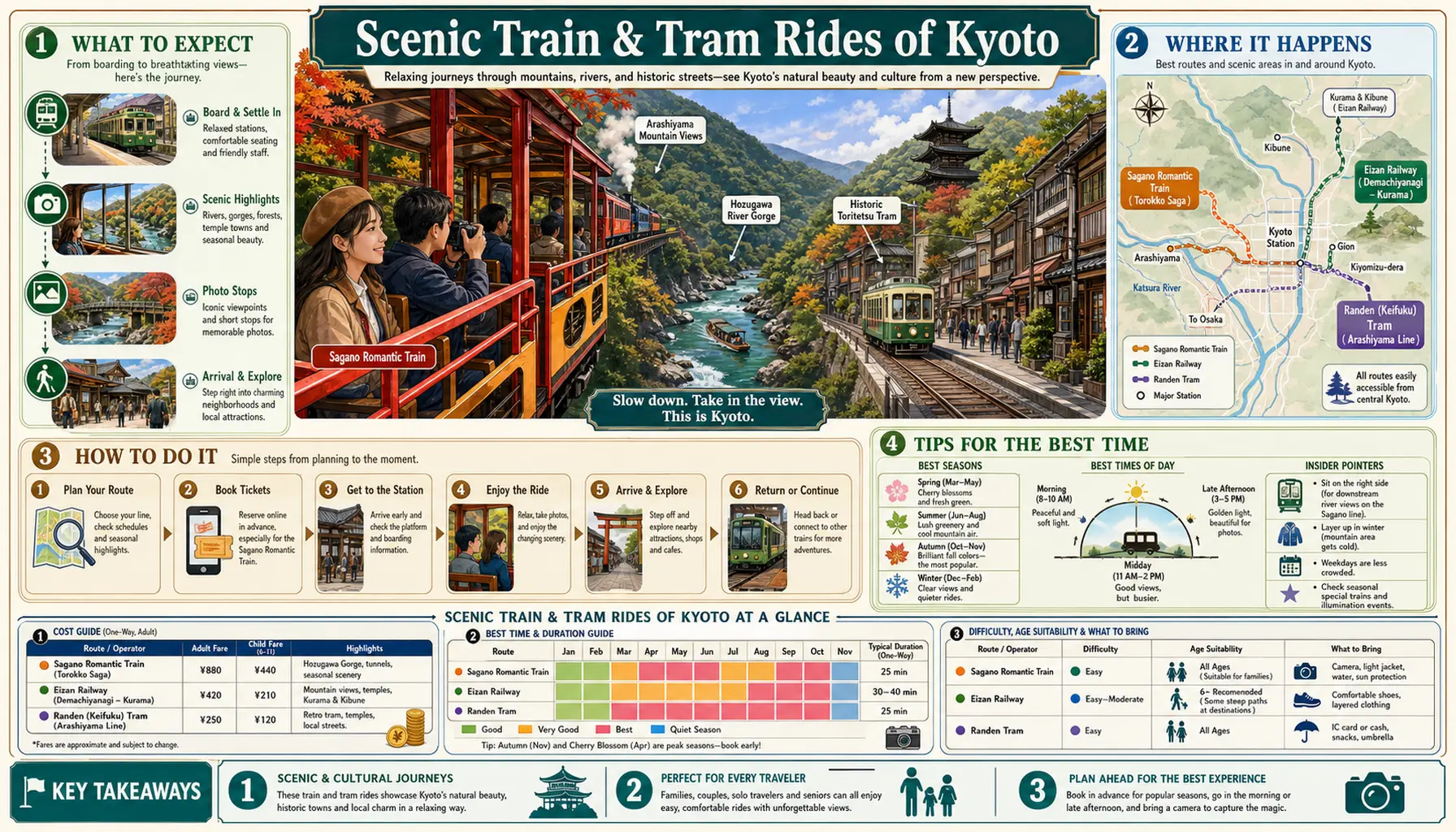
The Sagano Romantic Train runs open-sided carriages for about twenty-five minutes along a ledge above the Hozu gorge, from Saga-Torokko to Kameoka, at a speed slow enough to watch rafts on the river below. It is the best known of a whole set of small lines that exist mainly for the view. Kyoto kept its last tram, still runs an observation car into the northern mountains, and has a cable car climbing to Kurama — none of it expensive, and all of it easier to reach than the sightseeing buses.
The Randen tram and the western line
The Randen — formally the Keifuku Arashiyama line — is Kyoto's only surviving tram, running from Shijo-Omiya out to Arashiyama in around twenty-five minutes on a flat fare. It street-runs in places and cuts past back gardens in others. Between Narutaki and Utano the track passes under roughly two hundred cherry trees that arch right over the rails; in early April the trams stop in the middle of that stretch at night with the lights off. Arashiyama station has a foot bath on the platform and a forest of illuminated fabric poles. A day pass is cheap and worth it when branching onto the Kitano line.
Gorge, mountains and the museum
The Sagano torokko usually runs from March to late December and closes for winter; seats sell out in autumn, so booking at a JR ticket office in advance is wise. Many people ride it one way to Kameoka and return by Hozugawa river boat, which takes about two hours. North of the city, the Eizan line's Kirara cars have side-facing observation seats for the maple tunnel between Ichihara and Ninose, lit up for a couple of weeks each November, ending at Kurama where a short cable car climbs the hill. For rolling stock rather than views, the Kyoto Railway Museum at Umekoji keeps a working turntable and steam shed.