Staying Safe in Kyoto
A visual guide from the Kyoto travel guide — see all posters in Visual Guides.
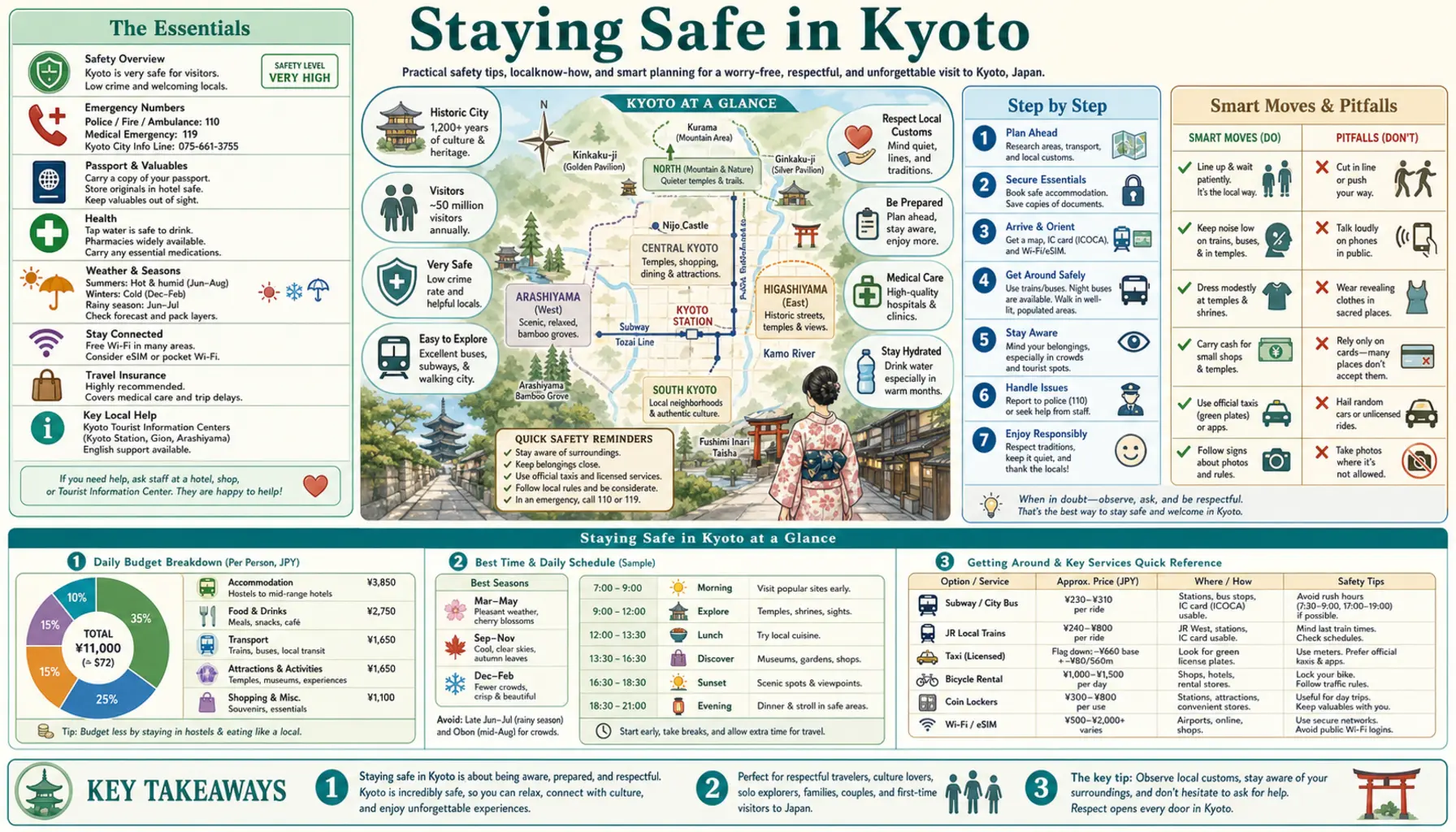
Ask someone who lives in Kyoto what they actually worry about and crime rarely comes up. What does: the basin's August heat, which regularly sits above 35C with humidity that makes the Higashiyama hills feel twice as steep; the impound trucks that clear bicycles off the footpaths around Shijo-Kawaramachi; and the small number of touts working the lanes off Kiyamachi after ten. Add the press of people on bus 205 at rush hour and you have most of what goes wrong here. None of it is frightening, and all of it is easy to plan around.
What actually goes wrong
Petty theft is rare enough that people leave bags on cafe chairs, but Kyoto has its own hazards. Bicycles left outside the marked bays near Shijo-dori and Kawaramachi get removed, and retrieving one usually costs a few thousand yen plus a trek to an out-of-town impound lot. In the drinking lanes between Kiyamachi and Pontocho, a handful of touts steer visitors into bars with unadvertised cover charges, so walk past anyone who approaches you on the street. Summer heat is the genuine danger: heatstroke cases climb every July and August, and the tunnels of gates on the Fushimi Inari climb trap the humidity rather than let a breeze through.
Practical habits
Emergency numbers are 110 for police and 119 for fire and ambulance, though English support is limited, so keep a translation app handy. Every neighbourhood has a koban police box, and Japan's lost-property system genuinely works: items handed in at Kyoto Station or on a bus usually resurface within a day or two. Carry water on any hill walk, start Daimonji or Atago early, and turn back if a typhoon warning is posted, since mountain trails around Kiyotaki and Kurama close after heavy rain. In Gion, several private alleys off Hanamikoji are signed against entry and photography, with fines advertised, so stay on the public streets.