War and Resistance History in Kyoto
A visual guide from the Kyoto travel guide — see all posters in Visual Guides.
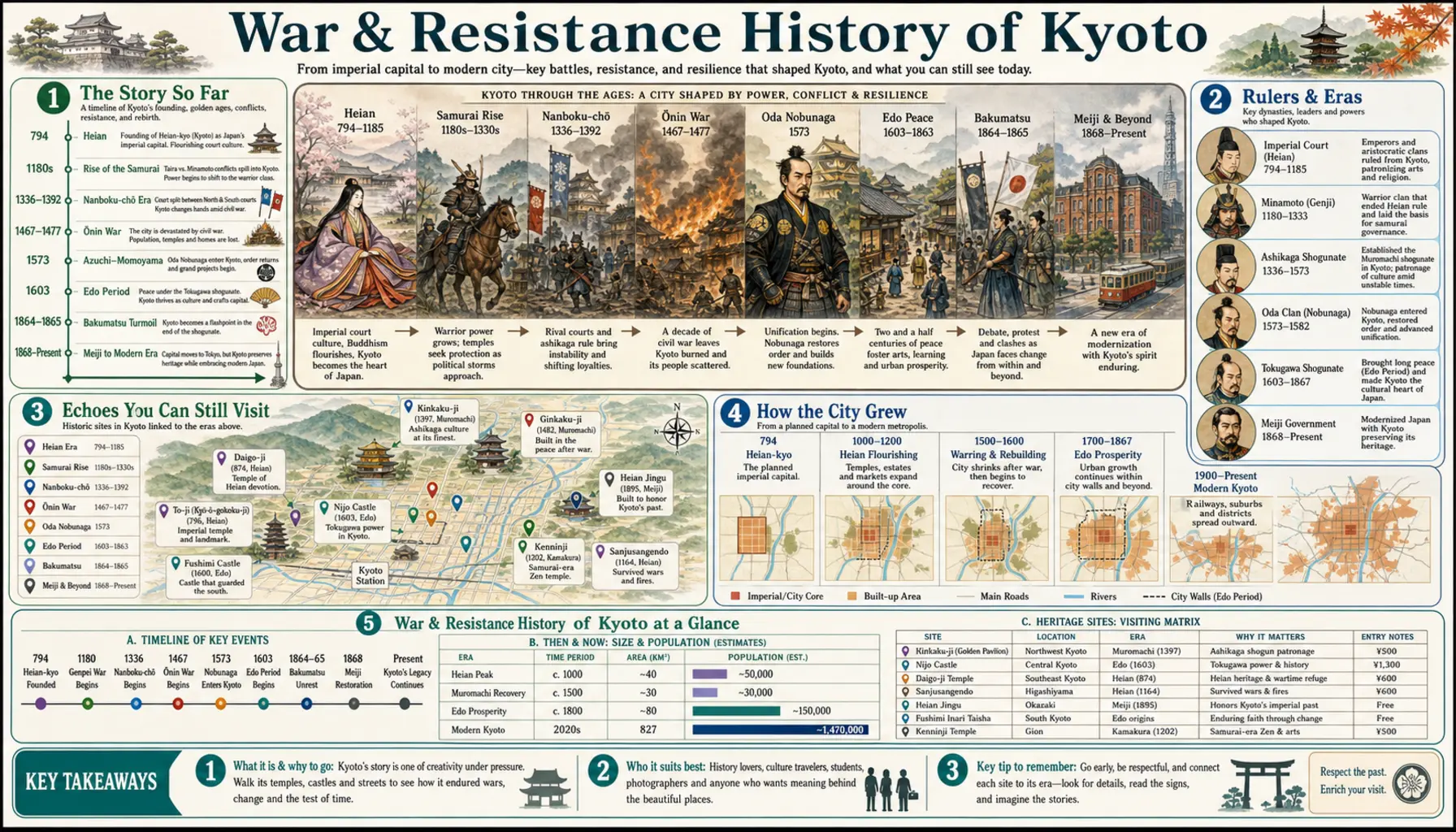
Kyoto is usually described as the city that was spared, and largely it was. American planners took it off the atomic target list and it never suffered the mass firebombing that flattened Osaka. But the war left marks. Two small air raids hit Umamachi in early 1945 and Nishijin that June, killing dozens between them. Whole rows of houses were pulled down to create firebreaks, which is why Oike-dori and Gojo-dori are improbably wide today. And an earlier conflict, the street fighting of the 1860s, burned more of central Kyoto than the 1940s ever did.
Sites to see
The Ryozen Museum of History in Higashiyama covers the 1860s in detail, from the Shinsengumi and the Ikedaya raid to the assassinations that ran through these streets, and the hillside cemetery above it holds Sakamoto Ryoma's grave with a view over the city. In Mibu, the Yagi residence still shows a sword cut in a door frame from the Shinsengumi's time as lodgers there. Look at the bronze finials on Sanjo Ohashi for nicks attributed to the same decade, and at the Hamaguri Gate on the west side of Kyoto Gyoen for damage from the 1864 rebellion that burned much of the centre.
The twentieth century
For the modern war, the Kyoto Museum for World Peace at Ritsumeikan University in Kinugasa is the serious institution, unusually direct about Japan's conduct across Asia as well as the home front, with English labelling on the main displays and a half-hour bus ride from the centre. In Uji, the Utoro Peace Memorial Museum, opened in 2022, tells the story of Korean labourers brought in to build a wartime airfield and the settlement their families held onto for decades afterwards. Both are quiet and uncrowded, and both give context the temple circuit never touches. Allow roughly ninety minutes for each.