Ancient Ruins in Bangkok
A visual guide from the Bangkok travel guide — see all posters in Visual Guides.
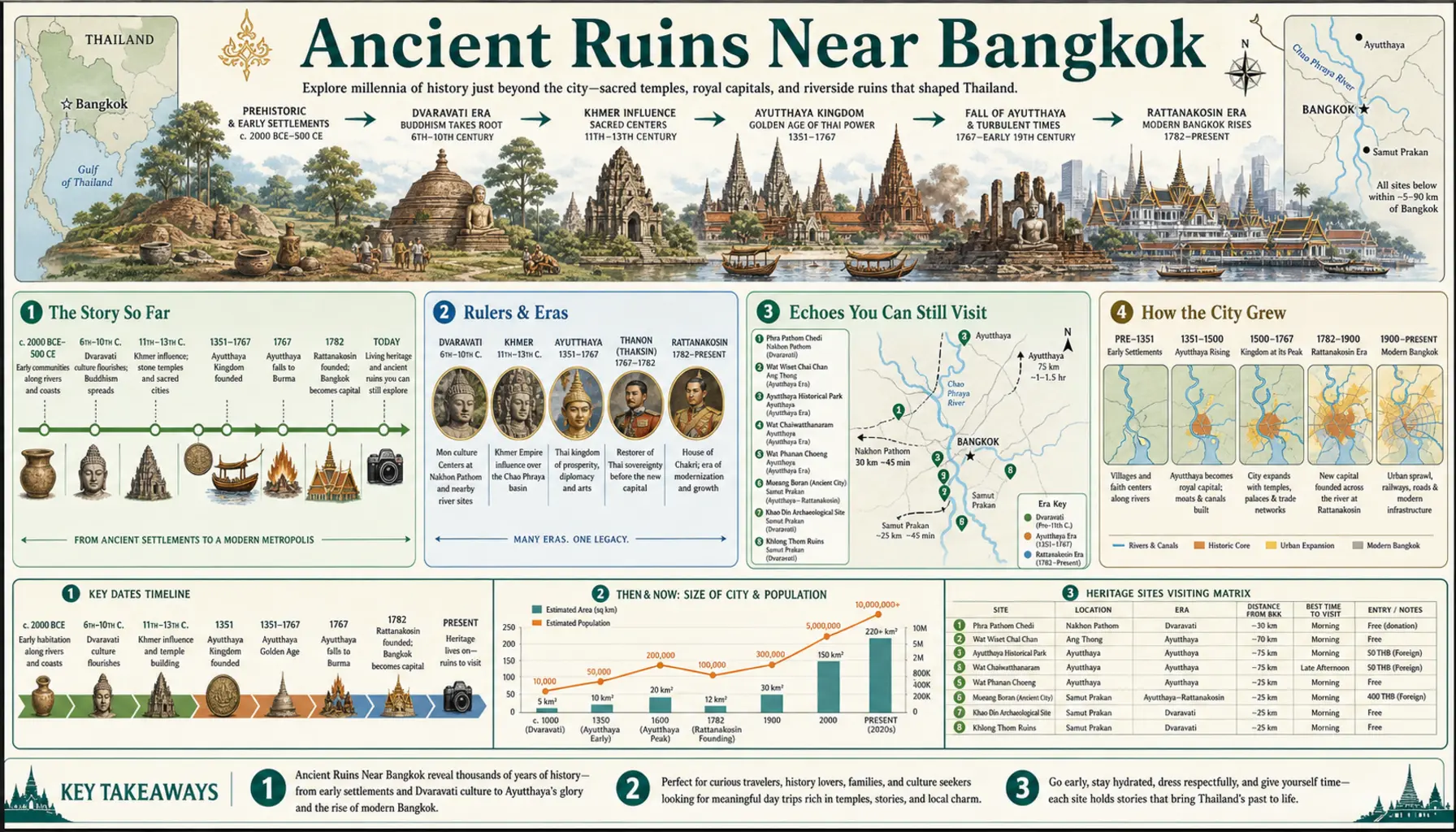
Bangkok was founded in 1782, which by regional standards makes it a new town. The genuine ruins sit about 80km north at Ayutthaya, the Siamese capital burned in 1767 and left as a field of brick prangs, headless sandstone figures and chedis leaning at odd angles. It is close enough for a day trip: trains and minivans run constantly, and the historical park is flat enough to cycle. Within Bangkok itself the surviving fragments are defensive rather than monumental, mostly whitewashed forts and a short stretch of the old city wall in Phra Nakhon.
Ayutthaya in a day
Trains leave Krung Thep Aphiwat Central Terminal for Ayutthaya through the day and take roughly an hour and a half; minivans from the Mo Chit area are similar. Bicycles rent cheaply near the station, and the core sites cluster within a few kilometres of each other. Wat Mahathat holds the sandstone Buddha head wrapped in banyan roots, Wat Phra Si Sanphet its three restored chedis, and Wat Ratchaburana a crypt you can climb down into. Save Wat Chaiwatthanaram, the Khmer-styled complex on the river's west bank, for late afternoon when the brickwork turns orange.
Beyond Ayutthaya
Lopburi, another hour north by train, has Prang Sam Yot: three laterite Khmer towers from roughly the twelfth or thirteenth century, now colonised by a large and confident macaque population that will take sunglasses given the chance. Sukhothai is an overnight rather than a day trip, but its park is the gentler, greener ruin field. For a compressed version, Muang Boran in Samut Prakan reproduces monuments from across Thailand at reduced scale on a huge landscaped site, reached via the BTS Sukhumvit line to Kheha and a short local ride. Start early at any of them, since shade is scarce.