Best Time to Visit in Bangkok
A visual guide from the Bangkok travel guide — see all posters in Visual Guides.
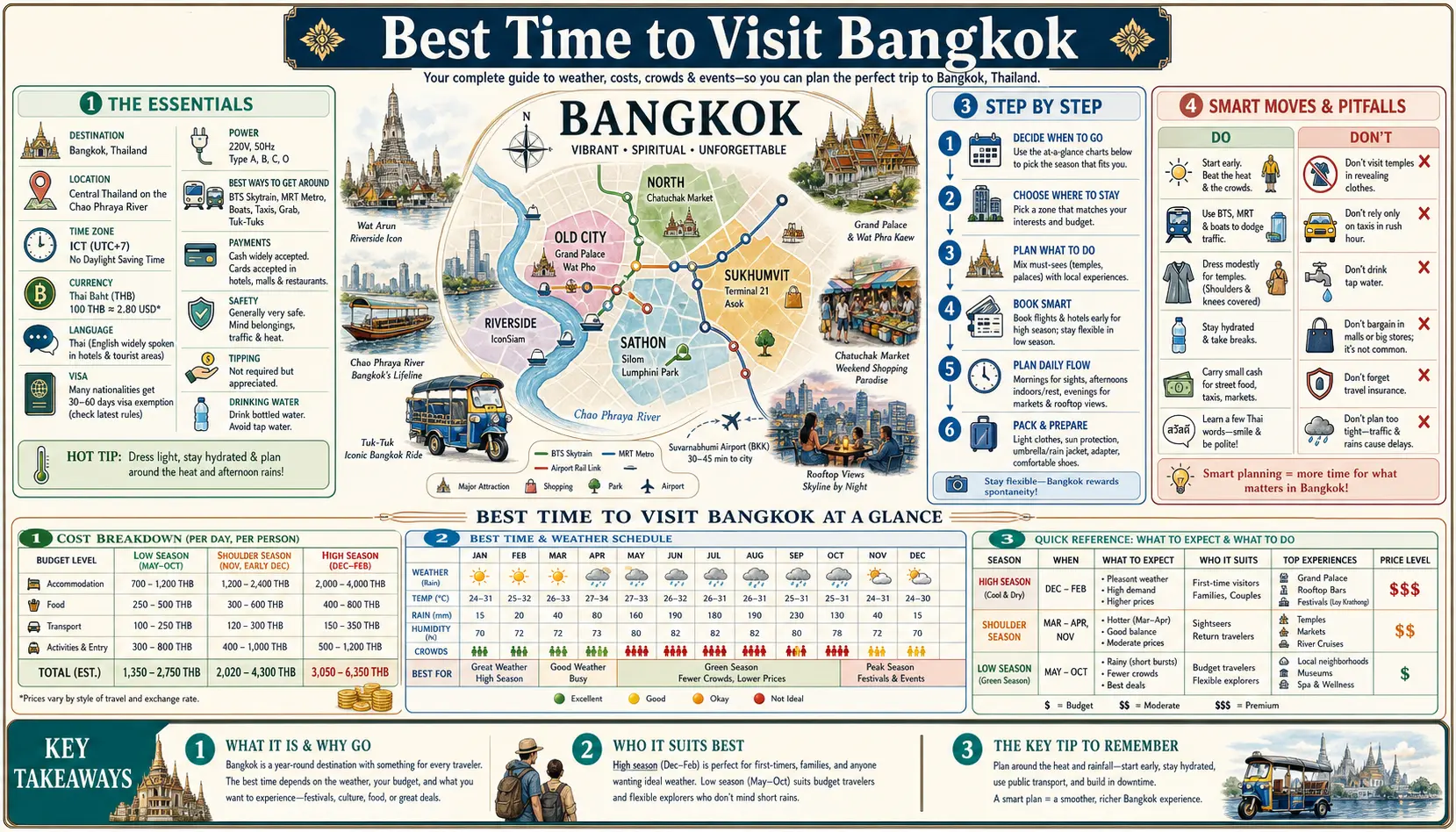
Bangkok has three seasons and only one of them is comfortable. From late November into February the northeast monsoon pushes drier air down the peninsula, daytime highs settle around 32C and the evenings turn genuinely pleasant, which is when a rooftop bar is worth the price. March to May is the hot season, and April is punishing, with highs usually in the high thirties, spikes towards 40C, and humidity that makes walking a chore. June to October is the rain, which usually means one heavy hour in the late afternoon rather than a washed-out day. Prices track the weather closely.
Month by month
Late November through February is peak season: clearest skies, lowest humidity, highest hotel rates, and the Christmas to New Year fortnight booked out well in advance. Loy Krathong falls on the November full moon and puts candles on the river and the canals. Chinese New Year, in late January or February, turns Yaowarat into a street party. March warms up quickly, and April brings Songkran on the 13th to 15th, when Silom, Khao San and Siam become water fights and much of the city shuts. September and October are the wettest months, when low-lying sois off Sukhumvit flood briefly after heavy rain.
Trade-offs worth making
The rainy season is underrated. Hotel rates drop noticeably, the parks are green, the light after a storm is excellent, and the downpours are usually short enough to sit out over a coffee. Carry a small umbrella, wear sandals you do not mind soaking, and keep the BTS and MRT in mind as a dry route across town. The one real drawback of the cool season is air quality: fine-particle pollution typically peaks between January and March, when regional burning and still air combine, so check a pollution app if you are sensitive and keep an indoor day or two in reserve.