Cooking Classes and Food Tours in Bangkok
A visual guide from the Bangkok travel guide — see all posters in Visual Guides.
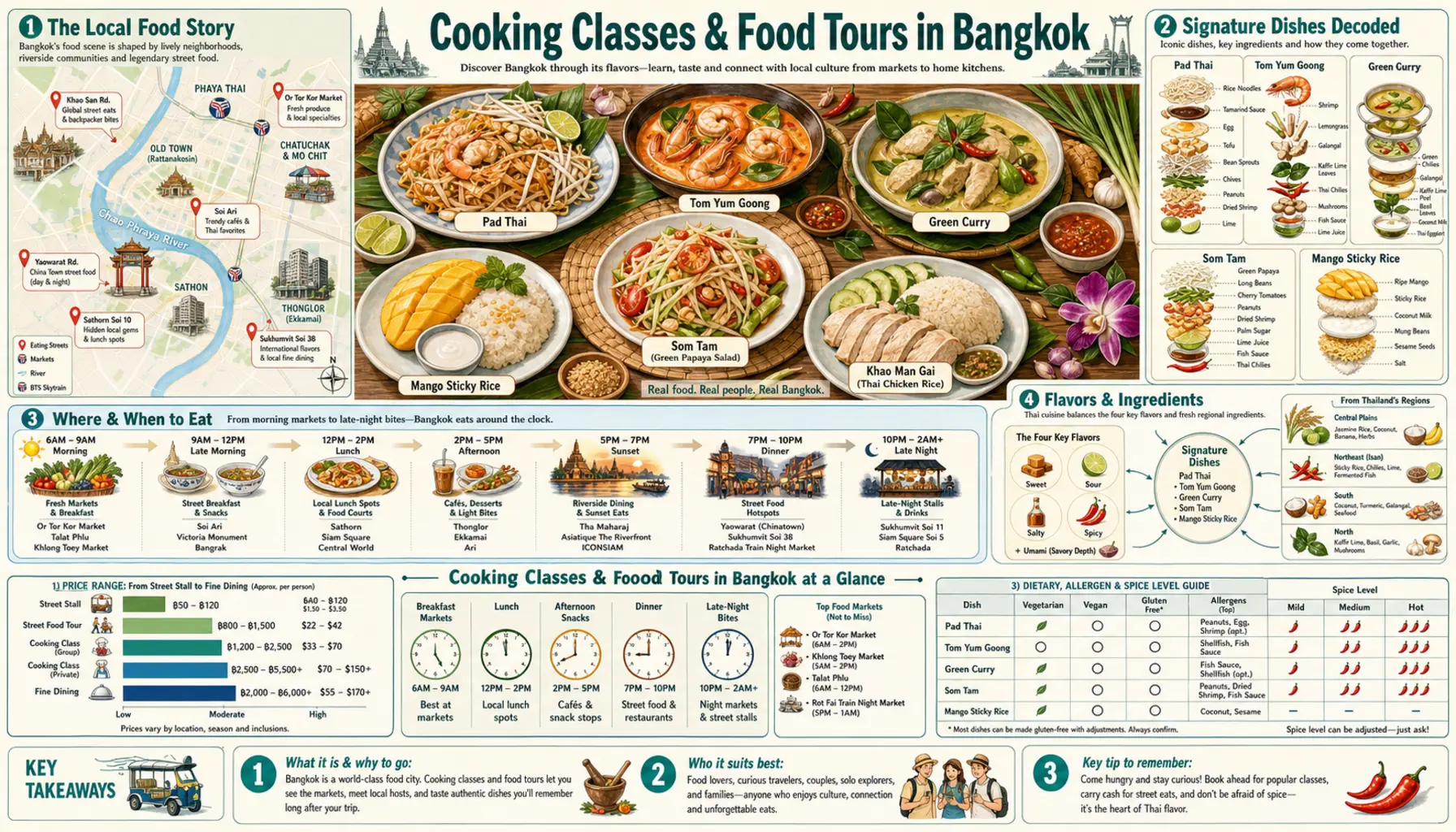
The good cooking classes in Bangkok start at a market, not at a stove. An hour before you cook, someone walks you past the galangal and the lesser galangal and explains why the wrong one ruins a tom yum, then makes you smell four kinds of basil. After that the cooking itself is unhurried: four or five dishes over three or four hours, usually including a curry paste pounded from scratch in a granite mortar, which is heavier work than it looks and completely changes what you think curry is supposed to taste like.
Choosing a class
Silom Thai Cooking School runs a compact market walk followed by four dishes and is the straightforward budget-friendly option in the Silom lanes near BTS Chong Nonsi. Baipai, in a garden villa out towards Lat Phrao, is more polished and generally includes hotel pickup. Blue Elephant teaches in a restored 1903 mansion by BTS Surasak and sits at the formal, chef-led end of the scale. Amita, on a canal in Thonburi, is reached by boat and taught in a family garden. Expect roughly 1,000 to 2,500 baht depending on the school, morning slots for the freshest markets, and vegetarian versions if you ask when booking.
Food tours
Evening walking tours of Yaowarat are the most rewarding format: about three hours, six or seven stops, and a guide who orders the things you would not, from kuay jab in peppery broth to braised goose and pomegranate juice off a cart. Tuk-tuk night tours cover more ground, typically pairing Chinatown with the flower market at Pak Khlong Talat around midnight. Bang Rak and Talat Noi tours concentrate on Thai-Chinese shophouse cooking and are gentler on the legs. Arrive hungry rather than fasting, since the pace is steady, portions are shared and most tours end on dessert rather than a full meal.