History Timeline of Bangkok
A visual guide from the Bangkok travel guide — see all posters in Visual Guides.
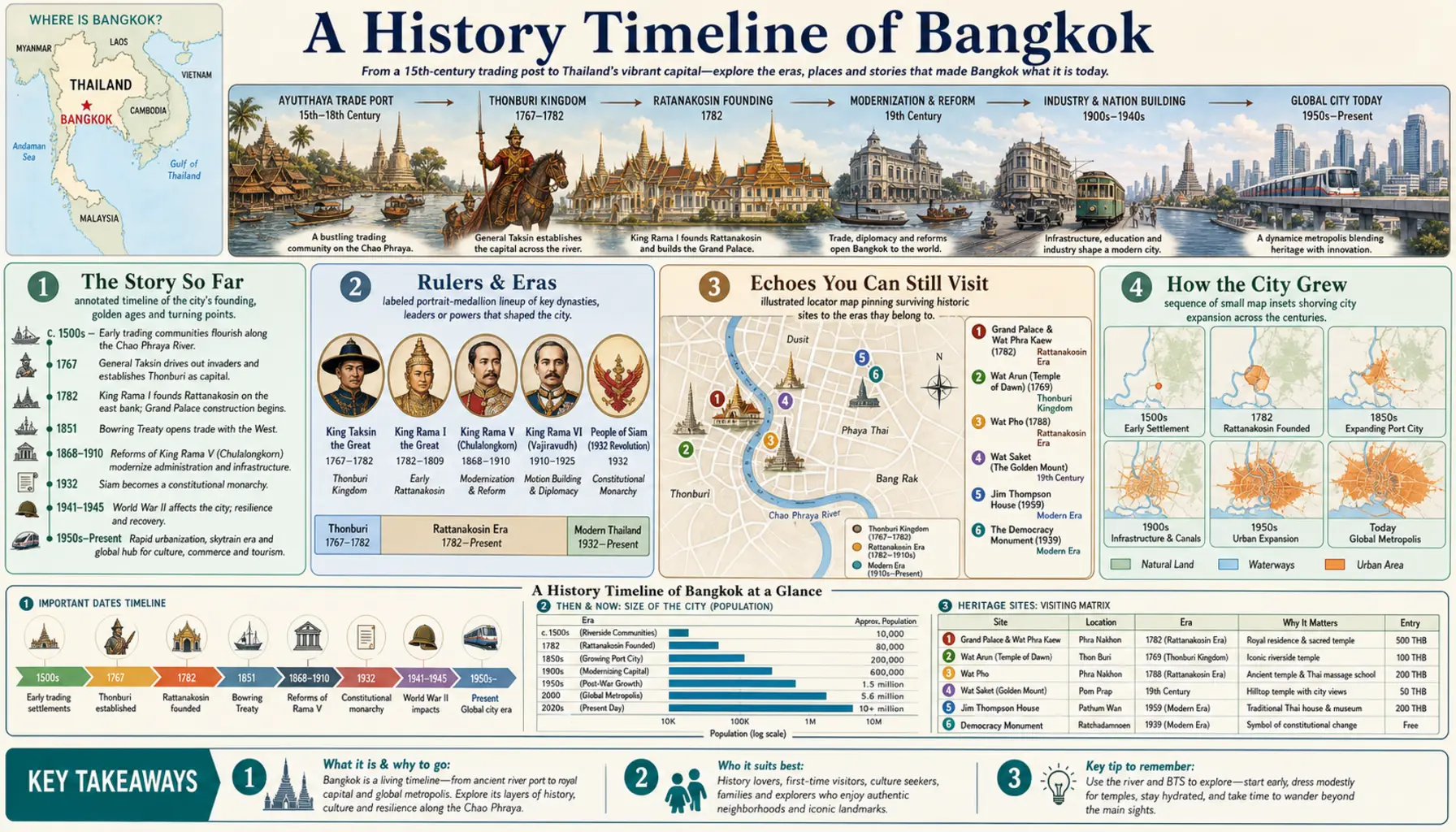
Bangkok is younger than it looks. In 1782 the capital moved across the river from Thonburi, and a canal was cut to turn the new royal quarter into an island. Everything since has layered onto that grid: trading treaties, the first paved road, the end of absolute monarchy, an American war that built out Sukhumvit, a financial crash that left a half-finished tower standing over the river. The result is a city where a 1930s bascule bridge and a 314-metre glass tower share the same stretch of skyline.
From canal town to capital
Rama I founded the city in 1782 and had Khlong Rop Krung dug to enclose the Rattanakosin quarter. The Bowring Treaty of 1855 opened Siam to foreign trade, and Charoen Krung, the first road laid for wheeled traffic, followed in the 1860s. The Paknam incident with French gunboats in 1893 pushed the country to modernise quickly: railways from the 1890s, Hua Lamphong station in 1916, tramlines threading the old town. The revolution of 1932 ended absolute monarchy, and both Democracy Monument and the Memorial Bridge date from that same decade.
The modern city
American rest-and-recreation spending during the Vietnam War in the 1960s and 70s built out Sukhumvit and Patpong and set the template for the city's nightlife. The 1997 financial crisis stopped construction mid-pour, and the unfinished Sathorn Unique tower remains its most visible scar. The Skytrain opened in 1999 and the metro in 2004, remaking how the city moves, with Suvarnabhumi following in 2006. More recently ICONSIAM reshaped the riverfront in 2018, and Krung Thep Aphiwat Central Terminal replaced Hua Lamphong as the main rail gateway.