UNESCO World Heritage in Bangkok
A visual guide from the Bangkok travel guide — see all posters in Visual Guides.
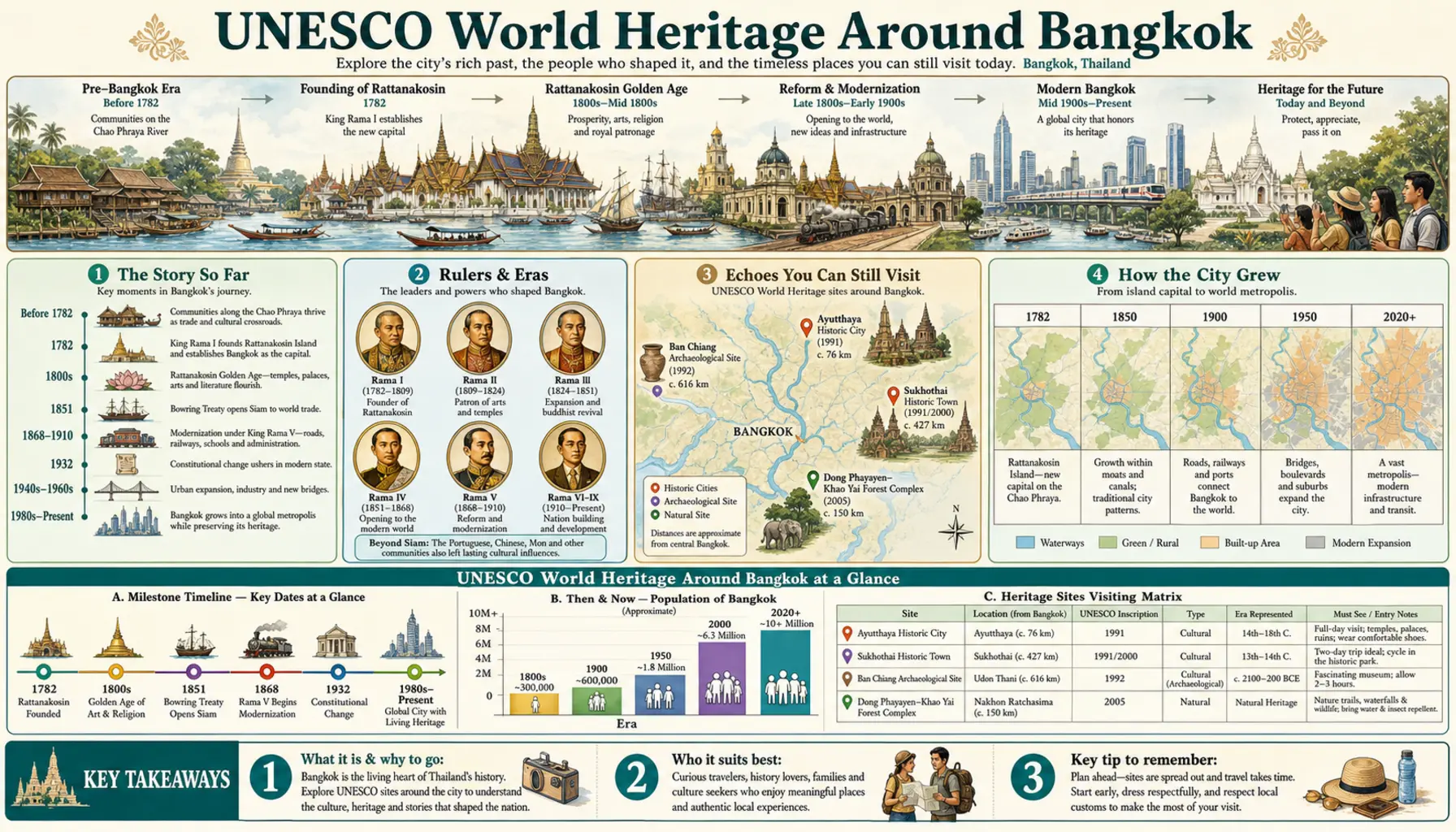
Bangkok is not itself on the World Heritage list — old Rattanakosin has been floated as a candidate for years — but three inscribed sites are within a morning's travel. Eighty kilometres upriver, Ayutthaya's brick prangs stand in open parkland where a city of a million people burned in 1767; to the north-east, the Dong Phayayen–Khao Yai forest complex still has wild elephants crossing the road at dusk. The capital's own UNESCO credentials are quieter: a stone-inscription archive at Wat Pho and a City of Design listing earned in 2019.
The sites within reach
Ayutthaya Historical Park, inscribed in 1991, is the obvious one: Wat Mahathat's sandstone Buddha head grown into a fig root, the three bell-shaped chedis of Wat Phra Si Sanphet, and Wat Chaiwatthanaram out on the riverbank, which photographs best in the last hour of light. Dong Phayayen–Khao Yai, listed in 2005 for its forest and wildlife rather than its buildings, covers Khao Yai National Park about three hours north-east, with the Haew Suwat and Haew Narok waterfalls inside it. Kaeng Krachan Forest Complex, added in 2021, lies roughly three hours south-west beyond Phetchaburi.
Getting there
Ayutthaya is the only one that works without a car. Trains leave Krung Thep Aphiwat Central Terminal for Ayutthaya station several times a day and take roughly an hour and a half; minivans run from Mo Chit. From the station a small ferry crosses to the island, where bicycles and tuk-tuks wait — the park is spread over several kilometres, so pick one or the other rather than walking it. Khao Yai and Kaeng Krachan realistically need a hired car or a tour, and both reward an overnight instead of a dawn-to-midnight round trip. Expect a foreign-visitor fee at national parks, typically a few hundred baht.